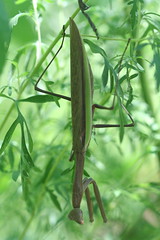
Saw this wonderful mantid at Prairie Park this afternoon. Just hanging out reminding me it's time to check up on climate change.
First off in California we have a voter initiative called Proposition 23 which attempts to roll back California's ambitious goals in the area of reducing dependence on fossil fuels. Who are main backers funding this proposition? If you guessed oil companies..you would be right according to this source:
http://www.dailydemocrat.com/rss/ci_15837869?source=rss
By the way remember that Western Kansas representative that said global warming will be good for plant growth? Makes sense since more carbon dioxide leads to more photosynthesis, right? Well not so fast according to research reported on NASA's web site:
http://earthobservatory.nasa.gov/IOTD/view.php?id=45380&src=imgrss
Apparently between 2000-2009 over all net plant growth world wide has been negative. Gains in plant growth in some areas are offset by losses due to drought in other areas. So like so many things in our grand uncontrolled experiment on enriching the atmosphere with extra carbon dioxide the outcome is a bit murky.
Speaking of murky, seemingly subtle changes in ocean characteristics may have big effects. A couple of interesting papers point out how the ocean's color and murkiness may relate to ocean temperatures and indirectly the severity of hurricanes. In a study reported in Science (http://news.sciencemag.org/scienceinsider/2010/08/sea-murkiness-affects-hurricanes.html), scientists fortuitously found that areas of the ocean with less phytoplankton in surface waters seem to have fewer hurricane type storms. This is believed to be because phytoplankton absorb light and raise the temperature of the surface waters which in turn affects the development of tropical storms. In the absence of phytoplankton light can penetrate deeper into the ocean so the surface waters don't heat up so much.
Now there may be a complex tie in with climate change. Another study discussed in Scientific American (http://www.scientificamerican.com/article.cfm?id=phytoplankton-population)looking at long term trends in phytoplankton abundance using a long term global data set suggests that phytoplankton abundance has declined by 40% since 1950. The scientists suspect that the decline is linked to warmer ocean temperatures because warmer surface temps reduce the exchange of water between the surface layers where the phytoplankton grows and cooler nutrient rich layers. To me this seems plausible since exactly this type of "stratification" is extremely well documented in the scientific literature.
The disturbing thing about this apparent reduction in phytoplankton abundance is that much of the oxygen in our atmosphere is produced by phytoplankton and phytoplankton are the base of oceanic food chains.
There is an interesting blog entry on the Accuweather web site (http://www.accuweather.com/blogs/climatechange/story/34446/global-temperature-trends-with-1.asp) looking at global temperature trends and decrying cherry picking of data by all sides in the climate change debate. Lots of graphs so you can judge for yourself.
By the way, Accuweather presents an analysis of the data for July 2010 in terms of how that fits in with long term climate trends: http://www.accuweather.com/blogs/climatechange/story/35467/observed-temperatures-from-jul-2.asp. The conclusions seems to be that July 2010 was the fifth warmest on record. To me this suggests that the much anticipated cooling trend has not been happening. Other researchers (http://data.giss.nasa.gov/gistemp/2010july/) are reporting that the first 6 months of 2010 are the warmest on record.
The NASA report says:
"The 12-month running mean of global temperature achieved a record high level during the past few months. Because the current La Niña will continue at least several months, and likely strengthen somewhat, the 12-month running mean temperature is expected to decline during the second half of 2010."
Note that they draw this conclusion from the 12 month running mean which includes the last five months of 2006 along with the first seven months of 2010. But again no suggestion of a long term cooling trend.
By the way, remember climate gate? Well the scientists involved have been basically cleared of any wrong doing by a British panel as explained in this article (http://www.nytimes.com/2010/07/08/science/earth/08climate.html?_r=2&src=mv) from the NY Times.
There were some problems noted by the panel that cleared the scientists.
Quoting from the Times article:
"But the panel also rebuked the scientists for several aspects of their behavior, especially their reluctance to release computer files supporting their scientific work. And it declared that a chart they produced in 1999 about past climate was “misleading.”
Personally I think there are some major issues that need to be addressed about the management and access to large data sets of all sorts, not just those related to climate change but that's a whole other topic!
cross posted from http://www2.ljworld.com/weblogs/dangerous-ideas/2010/aug/22/just-hanging-around-and-c/
Showing posts with label Ecology. Show all posts
Showing posts with label Ecology. Show all posts
Tuesday, August 24, 2010


Saturday, December 22, 2007
At Disney World...part I

Last week Mme. D and I went to Disney World in Orlando. This is our 3rd trip together and my first since I began blogging. We left last Sunday the 16th and got back early on Friday morning just in time to encounter the snow that hit today.
I have always had a sort of love/hate relationship to Disney. On the love side-as is the case with many of my generation, I grew up with Disney characters and movies. Watching the Walt Disney show on Sunday night was something I looked forward to. I fondly remember movies such as Flubber, and Swiss family Robinson.
My favorite movie when I was 10 or so was 101 Dalmations-not the recent remake but the original cartoon. I am not sure what I liked about this movie but was thinking about this just last night and I believe it had to do with the dogs communicating the plight of the kidnapped Dalmatians. I knew even at that age that animal communication is generally not so detailed but I remember thinking that there must be a whole secret world of communication we humans are not aware of. Of course this insight proved to be correct if the particulars were wrong.
At any rate, the movie was serialized in the comics and I loved the movie so much that I actually collected all the strips, taped them together in sequence and made a viewer out of a cardboard box and some pieces of wood so that I could run the strip backwards and forwards and pretend it was a TV-today we might say a VCR or DVD. What's odd is that 101 Dalmations also sensitized me to the flip side of Disney. Cruella Deville is totally dastardly and I can remember thinking that she has a French name. At that time I had become sensitized to a sort of mild ethnic dislike between the Irish and the French communities in my home town and wondered if Deville wasn't some sort of anti French swipe.
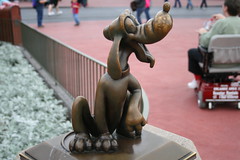
The characters are very one dimensional-that is part of the appeal for children and I don't think adults are immune from that appeal either. Disney today is a lot more than the cartoon characters-not only is it a media empire in all sorts of ways but the theme parks have expanded to vast merchandising and real estate empires. For instance we own a time share so we are able to stay in a Disney World resort, get transport to the parks do everything at the parks. For us it is a great vacation since my wife can no longer walk very far. Disney does take good care that its resorts and parks are friendly to persons with mobility related disabilities.

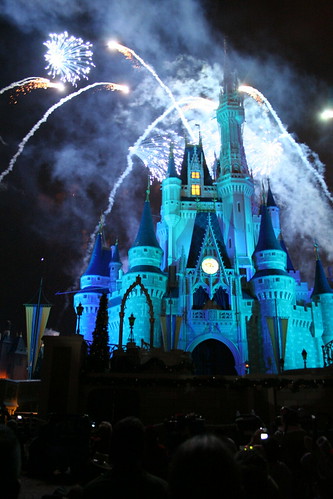
But Disney today is I think in disconnect both from its roots and also from the natural world and very carefully manages the information the visitor receives about the the resort. Now some of this is because Disney is all about fantasy and part of what makes fantasy work is control of information. But several things strike me as odd about Disney World in Orlando. First of all while you can get maps of the individual parks that is Magic Kingdom, Epcot, Animal Kingdom etc, there does not seem to be a readily available map showing the whole complex and how the different parks are connected. Second. When we first arrived the Disney Tour driver pointed out that Disney World in Orlando is the largest single site employer in the United States with 60, 000 employees-read cast members and also that by agreement with the State one half of the Disney property must be left natural. Yet I have not been able to find anything out about the natural side of Disney World and it does not seem accessible to visitors except as glimpsed while on the monorail system. What happens to the waste produced by the millions of visitors? How is Disney caring for the natural parts of its land, or is it?

Another curious thing is the lack of insect life. Orlando ought to be swarming with insects and yet I saw very few insects on site-a couple of ants, a katydid and one zebra Long wing butterfly. Now you might go so what? Probably most people are like my wife and think I take pictures of strange things. As she said...most people go to Disney for the characters but you shoot pictures of plants. But consider this-last May there was a butterfly garden in Epcot; my wife had taken her Mom down last May and saw it. But the the whole thing was just temporary. The larvae are reared indoors and trucked outside and allowed apparently to emerge in a screened in area. Not quite what I had pictured for a butterfly garden.

The whole Disney approach is technological, Julian Simon run amok. Now don't get me wrong I am not a luddite and I have always approved of the sort of forward vision that Disney has. But there is something curiously 20th century, curiously quaint and not in a nice way-about the disconnect between the corporate technology can solve everything and we really don't need nature and the the messiness of the real world. As I remind my students the real world is not Disney World.
This is the year of million dreams at Disney so I entertained myself and my wife... by dreaming of an alternative to Disney World called Paul's World. This would attractions such as:
- The natural selection walk. Leave your I-pods at home and match wits with the natural world including big cats and not so friendly snakes.
- The invasive species walk. Avoid the stinging fire ants, cut your way through Kudzu and help defend bluebirds from starlings.
- Germ pavilion. Test your immune system against 20 great old time pathogens including Mycobacterium tuberculosis, Plasmodium vivax and Yersinia pestis!
- Global warming water park. Experience the Florida of the the next century full of wonderful tropical parasites and snakes to challenge even the most seasoned survivalist.
- Creationist wonder park. Thanks to the wonders of synthetic biology combined with genetic archeology, come to the Jurassic and see just how well Adam and Eve would fare if they lived with dinosaurs. By the way, you play Adam or Eve.
Somehow my wife doesn't think these would be popular attractions. Perhaps not. But if I can dream more realistically then I dream that Disney will find a way to get out of the whole Spaceship Earth 20th century technology can do everything rut and turn its considerable resources to bringing about better understanding of the natural world-lessen that disconnect we have as a civilization towards nature at precisely the time when understanding the connection between humans and the rest of the natural world is so critical.
Yes I know, Disney is about fantasy but fantasy can be consciousness raising and it doesn't have to be heavy handed about it either. Maybe all it takes is a real butterfly garden with native butterflies and native vegetation. Maybe all it takes is a bit more transparency and a bit more show casing of the natural side of Disney and just a bit less merchandising of prepackaged dreams.
Monday, November 19, 2007
The Woods by the College:sustainability and synchronicity
 Sustainability and Synchronicity? Now this seems as an odd combination of concepts, so let me explain. The whole thing started a couple of weeks ago when and another faculty member and I were discussing our College's push to promote sustainability across the JCCC campus. Several faculty members and one of our vice presidents had gone to a League of Innovation conference about sustainability and came back all fired up. This of course from my way of thinking is quite laudable and has led to lots of discussion about sustainability on campus.
But I wondered aloud to my colleague if people really understood the sort of sacrifices that true sustainability might entail. For example there are studies which have looked at our civilization's use of planetary resources and the damage we have done to the ability of our planet's systems to sustain our population. Several studies claim that we have effectively overshot the planet's capacity to sustain our population and that we would need to have the resources, biological and otherwise of several Earths to have a sustainable planetary population with the standard of living equal to that enjoyed by people of this country. See for example http://www.footprintnetwork.org/gfn_sub.php?content=footprint_overview.
Since we only have one Earth we have a little problem of insuring that everyone has a decent standard of living. Now one might argue that technology might help us here, but our track record on mobilizing new technologies has not been particularly good, unless you count the development of hybrid SUV's mobilizing technology in a sustainable way. We can hope for a transforming technology to save us. Scientific and technological development is notorious hard to predict, but the trend in resource use, destruction of habitat seem pretty clear and hard to avoid in the short run even we to develop a set of new sustainable technologies. Sustainability is important but I wondered to my colleague if it isn't in danger of becoming a feel good buzz word...like organic or ecology.
At any rate...to the woods. At JCCC we have a wonderful campus wonderful resources for teaching, great staff and an energetic new President. Last week I was riding to work on the bus and was noting the contrast between the college's brick work architecture and well groomed appearance and the scruffy looking patch of woods next to the college's entrance. What a contrast-we are thinking of sustainability in terms of the engineering and management systems we use and how we can tweak them to reduce waste-kind of the Spaceship Earth paradigm. And yet natural systems as epitomized by this patch of woods manage to sustain themselves quite nicely even though the self regulatory nature of biological communities is really an illusion compared to the designed regulation of our technological systems. So from here came this poem that attempts to capture in a few lines some of these ideas:
So to the poem:
The Woods by the College
Not all that long ago this whole space
Was prairie of tall and mid grasses
Swaying across the decades following
The shifting rains east then west,
Except here where a spring feeds
The roots of mock orange and locust
And hack berry and brambles.
Somehow this lot survived by a whim
The building of the campus.
But no one visits here unless
We take our students to see
The stream cut in the grey clay,
Let them pick among the briers,
Trees muffling traffic and shouts
From the tennis courts.
We let then scrape samples
From the wood's trickling womb
And a cardinal scolds us over the water sounds
As we leave for the geometry of brick,
Leave behind the illusion of design
That sustains itself in the real world,
One Earth deep as we say we want
Though our design is many Earth's deep
Beneath the illusions we create.
Now to the synchronicity. That night my wife and I decided to get Chinese food and my "fortune" which by the way I pasted into my poetry journal reads:
"The one that recognizes the illusion,
does not act as if it real."
Thursday, June 07, 2007
Rachel Carson: At the Commons
The Commons at the University of Kansas held a program about the legacy of Rachel Carson tonight (June 7) at the Spencer Museum of Art on the KU campus. Rachel Carson was a major influence on my development, so I naturally went to this program. The program consisted of a talk on art related to environmental issues followed by a showing of a 1993 documentary, Rachel Carson's Silent Spring and a discussion about Carson.
 I missed the art discussion , but did catch both the documentary and the final discussion. These were facilitated by Maril Hazlett (pictured), a local environmental historian and researcher at The Land Institute. Hazlett made several important points about Carson. She called Carson a "rare creature" in that she was a completely integrated person, one who combined science with a deeply spiritual reverence for life. Carson told people that they are ecological creatures and that if you put toxins in the environment they will come back to you. She discussed a famous quote from Silent Spring:
Hazlett noted that Carson was not, contrary to what some of her detractors think, against all use of insecticides and other pesticides, but very concerned about their abuse. Carson talked about "prudent concern" and cautioned against extremes and indeed was a moderate voice with respect to the environment and the use of chemicals, a fact that Hazlett noted, is largely forgotten.
I had seen the documentary before, and if you get the chance it is worth seeing. Younger viewers of the documentary might not believe some of the scenes of DDT and other pesticides being sprayed and kids playing in the spray, but in the 1950's that was common. I can remember eagerly awaiting the mosquito truck so I could play in the wonderful blue fog. We were never told it was potentially dangerous.
The documentary was not completely anti DDT and noted the pivotal role DDT played in World Was II in controlling typhus which is spread by lice. The documentary also re-enforced Carson's concern about the abuse of pesticides in the hands of untrained individuals.
After the discussion Hazlett took questions and comments from the audience. One questioner asked for Hazlett to comment on an essay in a recent NY Times essay by John Tierney who argues that Carson's legacy is one of chemophobia and that:
"The human costs have been horrific in the poor countries where malaria returned after DDT spraying was abandoned. Malariologists have made a little headway recently in restoring this weapon against the disease, but they’ve had to fight against Ms. Carson’s disciples who still divide the world into good and bad chemicals, with DDT in their fearsome “dirty dozen.” "
This echoes some of the claims made about Carson in websites such as Junk Science that I have blogged about elsewhere, and Hazlett correctly points out that DDT is still used in other parts of the world and that Tierney's tying of the failure to control Malaria to Carson is not accurate. As an aside, I believe Tierney also plays fast and loose with chemistry, not understanding that Malaria and other chlorinated hydrocarbons really are different from other more naturally occurring chemicals that we encounter. DDT and many of the newer pesticides is not part of the chemical background in which we evolved.
I asked Hazlett, why there seems to be a spike in criticism of Carson today. Hazlett attributes part of the spike to the fact that this year is the centenary of Carson's birth. But she notes that the ultimate reason maybe that we as a society still have not developed a consensus as to the best way to evaluate and deal with new technology.
The upshot seems to be that Carson really was a moderate and should not be blamed for people's misunderstanding of her position.
Other Links suggested by Hazlett:
Environmental Working Group
http://www.ewg.org/
The Rachel Carson Homestead
http://www.rachelcarsonhomestead.org/
Also see the Rachel Carson Centennial Blog
http://rcbookclub.blogspot.com/
Technorati Tags:
insects
science
environment
Rachel Carson
 I missed the art discussion , but did catch both the documentary and the final discussion. These were facilitated by Maril Hazlett (pictured), a local environmental historian and researcher at The Land Institute. Hazlett made several important points about Carson. She called Carson a "rare creature" in that she was a completely integrated person, one who combined science with a deeply spiritual reverence for life. Carson told people that they are ecological creatures and that if you put toxins in the environment they will come back to you. She discussed a famous quote from Silent Spring:
"It is not my contention that chemical insecticides must never be used," she wrote. "I do contend that we have put poisonous and biologically potent chemicals into the hands of persons largely or wholly ignorant of their potentials for harm. We have subjected enormous numbers of people to contact with these poisons, without their consent and often without their knowledge. If the Bill of Rights contains no guarantee that a citizen shall be secure against lethal poisons distributed either by private individuals or by public officials, it is surely only because our forefathers, despite their considerable wisdom and foresight, could conceive of no such problem."
Hazlett noted that Carson was not, contrary to what some of her detractors think, against all use of insecticides and other pesticides, but very concerned about their abuse. Carson talked about "prudent concern" and cautioned against extremes and indeed was a moderate voice with respect to the environment and the use of chemicals, a fact that Hazlett noted, is largely forgotten.
I had seen the documentary before, and if you get the chance it is worth seeing. Younger viewers of the documentary might not believe some of the scenes of DDT and other pesticides being sprayed and kids playing in the spray, but in the 1950's that was common. I can remember eagerly awaiting the mosquito truck so I could play in the wonderful blue fog. We were never told it was potentially dangerous.
The documentary was not completely anti DDT and noted the pivotal role DDT played in World Was II in controlling typhus which is spread by lice. The documentary also re-enforced Carson's concern about the abuse of pesticides in the hands of untrained individuals.
After the discussion Hazlett took questions and comments from the audience. One questioner asked for Hazlett to comment on an essay in a recent NY Times essay by John Tierney who argues that Carson's legacy is one of chemophobia and that:
"The human costs have been horrific in the poor countries where malaria returned after DDT spraying was abandoned. Malariologists have made a little headway recently in restoring this weapon against the disease, but they’ve had to fight against Ms. Carson’s disciples who still divide the world into good and bad chemicals, with DDT in their fearsome “dirty dozen.” "
This echoes some of the claims made about Carson in websites such as Junk Science that I have blogged about elsewhere, and Hazlett correctly points out that DDT is still used in other parts of the world and that Tierney's tying of the failure to control Malaria to Carson is not accurate. As an aside, I believe Tierney also plays fast and loose with chemistry, not understanding that Malaria and other chlorinated hydrocarbons really are different from other more naturally occurring chemicals that we encounter. DDT and many of the newer pesticides is not part of the chemical background in which we evolved.
I asked Hazlett, why there seems to be a spike in criticism of Carson today. Hazlett attributes part of the spike to the fact that this year is the centenary of Carson's birth. But she notes that the ultimate reason maybe that we as a society still have not developed a consensus as to the best way to evaluate and deal with new technology.
The upshot seems to be that Carson really was a moderate and should not be blamed for people's misunderstanding of her position.
Other Links suggested by Hazlett:
Environmental Working Group
http://www.ewg.org/
The Rachel Carson Homestead
http://www.rachelcarsonhomestead.org/
Also see the Rachel Carson Centennial Blog
http://rcbookclub.blogspot.com/
Technorati Tags:
insects
science
environment
Rachel Carson
Subscribe to:
Posts (Atom)