Showing posts with label biology. Show all posts

Thursday, November 21, 2013

Needles

needles from cypress
lit by November grey
clouds
pushed by wind
one brought inside on a shoe

Thursday, November 07, 2013

The Interaction of Light with Matter

The light turns up then down
as clouds scuttle in the wind.
Gold leaves gild my vision
and spread brassy sound
round and round.

Some are descending notes lost
in the still green honey suckle
whose red berries will fly ostinato
over the low drone of winter
and the crack of white crust.

Then there is a chorus of paw paw
singing with yellow pellucid soprano voice
in the dark drum understory,
cymbals clash in suddenly bronze light
that quickly dims to subito.


See: http://www.npr.org/2013/11/01/242356997/einsteins-real-breakthrough-quantum-theory

Saturday, October 26, 2013

Maybe if I stay very still...

Not many insects out after the first frost but I did find this wonderful Katydid pretending to be invisible. Actually it did a pretty good job of it.


Saturday, September 28, 2013

Another Visit to Konza Prairie.

Yesterday I had to go to Kansas State for a meeting on science core outcomes related to transferability **insert arcane educational jargon here** and since the meeting finished at noon, decided that I needed a Konza Prairie break. The grasses and forbs are just starting to turn to their fall reds and browns; the tree foliage is still pretty green.


So here are some pictures, some taken with my DSLR telephoto but some with my new phone (LG G2) and its pretty amazing camera (OK for a phone). The animated gif is made by G+ from photos taken with 'burst mode".  This is cool.

First, from the phone:


What I really like with my phone is the ability to touch the screen to select focus points that are also used for metering. For instance this picture originally had a bright blue sky but the tree trunk was badly underexposed. But focusing and metering on the trunk gave this picture. The sky is blown but I got the trunk detail I was looking for. And with a bit more fiddling I probably could have done a better job of this. OK I can do something like this with my DSLR but it is a bit more awkward.


From my DSLR (Canon 2i with 250mm telephoto).

I love the red ground color the grass seed heads are turning.


A Fritillary-not sure what species.  250mm telephoto lens.

Tuesday, July 23, 2013

Oops!

Oops! I really wasn't going to eat this cucumber leaf: honest!

Friday, April 05, 2013

Magnolia


Here is a pink Magnolia from campus. One thing I didn't realize is that it is possible to isolate DNA from Magnolia fossils going back to the Miocene (17-20 million years ago)  and use it to help understand the phylogeny of these trees.  See Kim et al (2003)  http://www.amjbot.org/content/91/4/615.full doi: 10.3732/ajb.91.4.615 Am. J. Bot. vol. 91 no. 4 615-620

Thursday, March 22, 2012

A little science can be dangerous....

Rick Santorum not only doesn't accept evolution but he is a well known global warming sceptic. Recently he has attempted to give a science lesson on photosynthesis, noting quite correctly that plants require carbon dioxide-carbon dioxide being a raw material for photosynthesis. Therefore carbon dioxide can't be bad. So he has bought into the same sort of reasoning promulgated by the site CO2 Science which collects data on how much better plants grow when carbon dioxide levels increase. This video, Seeing is Believing, is pretty representative of what's on CO2 Science and is pretty effective and quite correct as far as it goes. Under controlled conditions and with plenty of other nutrients carbon dioxide does make plants grow better. But there are some big questions as to whether or not this increased plant growth will be sufficient to overcome the increase of carbon dioxide due to human activity. Some studies such as this one suggest that soils in forests can take up extra carbon in response to increased carbon dioxide levels. Sounds fine- but as noted by this primer on carbon dioxide and the carbon cycle, human activity such as deforestation has caused a net release of carbon dioxide to the atmosphere. Plus, as oceans warm they also become less able to absorb carbon dioxide. One can argue about what will happen long term-but if the plants and other photosynthetic organisms are able to take up sufficient carbon dioxide why are atmospheric carbon dioxide levels still increasing with no sign of slowing? See this diagram from NOAA. Somehow the global warming skeptics who argue that plants can soak up the carbon dioxide are missing the big point- they may be right in theory , but globally something is awry with this thinking. Either on a global scale, plants and other photosynthetic organisms are not responding as "common sense" says they should or human activity is reducing the ability of natural systems to respond, as they other wise might, to increasing carbon dioxide concentrations.

Sunday, October 23, 2011

Reverse superposition

Reverse superposition by pdecell
Reverse superposition, a photo by pdecell on Flickr.
Via Flickr:
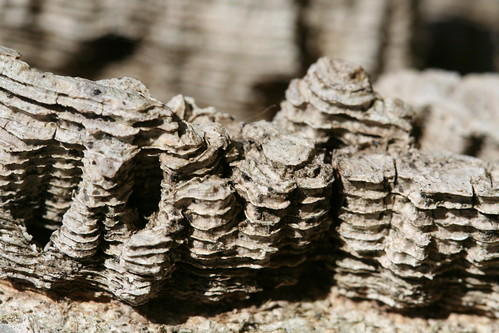
The principle of superposition is the common sense notion that in geological strata the oldest rocks are generally the lowest strata. Of course the way trees grow from the cambium out, in the bark the oldest layers are on the top.

Stained Glass Sumac

Stained glass sumac 2 by pdecell
Stained glass sumac 2, a photo by pdecell on Flickr.
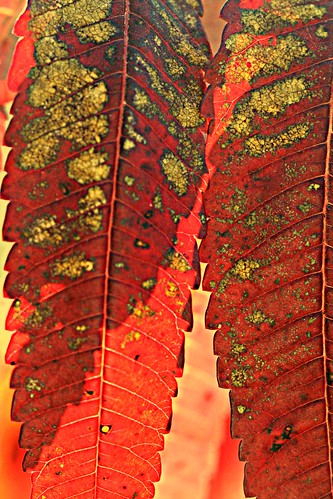
Partially skeletonized sumac leaves. I think of all the fall leaf colors I like sumac the best. especially when light is transmitted through the leaf.

Via Flickr:
Edited in Picnik to get rid of the blue cast on the upper portion of the original.

Tuesday, April 19, 2011

Pieces of Flower

Floral pieces

In lab today we saw creatures
From two of the three domains-
Identified cocci and bacilli,
Paramecium and Amoeba swimming
or streaming under cover glass.

Then the plants-mosses green,
With diploid sex brown and erect;
Fern's hidden gametophytes
Androgynous creatures dwarfed
By cozy sitting room fronds.

Finally we consider the lillies-
Pink and spotted petals,
Orange pollen shed from anthers,
Little orange creatures slithering tubes
Down the style for sperm swim to the eggs.

Linnaeus glimpsed the flower's
Blindness to our conceits
Though his colleagues spun around
In their shrouds, screamed:
"No proper plant does this!"

Lab over, petals and sepals and ovaries
Are wings pulled from flies-
Pieces of flowers diced and swept away-
All the bone white facts collected,
Objectives checked for the next quiz.

We return to our cages and sit,
Peeling our soft triploid carpels,
Blind in our shrouds.

Monday, January 03, 2011

Oops that's not right!

In my distant past I was a research assistant working with a scientist who had a whole bunch of pair wise correlations between variables in a very large data set. The researcher found some interesting correlations between some of these variables and complained that the statistician involved with the research said that the correlations were not significant even though looked at in isolation they were significant. I had to agree with the statistician and fortunately was able to convince my boss that the statistician was indeed correct here. My reasoning was basically by analogy-if you flip 100 coins you expect to find on average 50 heads and 50 tails and your results should vary around that by chance. Further, every once in a while, you expect to find say 20 heads and 50 tails just by chance and you would not get excited about that. In the same way if you have a slew of uncorrelated variables by chance you can get some significant correlations.

Scientists love statistically "significant" results but this last year a very interesting article titled "The Truth Wears Off" appeared in the New Yorker looking at a disturbingly common pattern in science, called the decline effect. Often, especially with complex phenomena initial experimental results are highly significant , but then with replication the results either are not so pronounced or disappear entirely. The results cannot be replicated. The article's author Jonah Lehrer gives a wide range of examples from both basic and applied science and lists a number of reasons why this phenomenon happens.

Some of the reasons discussed are bias toward positive results, include regression toward the mean, and publication bias, none of which by themselves explain what is going on. The most likely culprit seems to be selective reporting and this has actually itself been tested by a biologist by the name of Richard Palmer. Lehrer says the following about Palmer's investigation:

"Palmer’s most convincing evidence relies on a statistical tool known as a funnel graph. When a large number of studies have been done on a single subject, the data should follow a pattern: studies with a large sample size should all cluster around a common value—the true result—whereas those with a smaller sample size should exhibit a random scattering, since they’re subject to greater sampling error. This pattern gives the graph its name, since the distribution resembles a funnel....after Palmer plotted every study of fluctuating asymmetry, he noticed that the distribution of results with smaller sample sizes wasn’t random at all but instead skewed heavily toward positive results."

Palmer's results suggest that reporting bias is everywhere in science and Palmer concludes that:

“We cannot escape the troubling conclusion that some—perhaps many—cherished generalities are at best exaggerated in their biological significance and at worst a collective illusion nurtured by strong a-priori beliefs often repeated.”

The article gives a range of disturbing examples from a wide range of disciplines and gloomily concludes that:

"Such anomalies demonstrate the slipperiness of empiricism. Although many scientific ideas generate conflicting results and suffer from falling effect sizes, they continue to get cited in the textbooks and drive standard medical practice. Why? Because these ideas seem true. Because they make sense. Because we can’t bear to let them go. And this is why the decline effect is so troubling. Not because it reveals the human fallibility of science, in which data are tweaked and beliefs shape perceptions."

So what's to be done? From my perspective there are several things, some of which are discussed int he article. First of all scientists have to avoid what the article terms significance chasing-getting excited about seemingly significant correlations as my old boss did. Related to that, scientists need to be sure that they are indeed using appropriately conservative tests, that is tests that minimize the chance that an incorrect hypothesis will be accepted. Data needs to be open and available for scrutiny and experimental controls carefully laid out. When I teach, one one thing I tell my students is that the hypothesis and the experimental design has to be worked out in advance of testing the hypothesis including the sample sizes.

Maybe we forget- and don't properly train our students to remember- that a hypothesis is just that - it is a guess, perhaps informed by theory but it is still a guess and non significant results are still meaningful. Of course it would help if funding agencies by they governmental or private would remember that as well!


http://www.newyorker.com/reporting/2010/12/13/101213fa_fact_lehrer
Wednesday, December 22, 2010

Half Full or Half Empty?

There is a new Gallup poll surveying American's belief in evolution. The bad news is that 40% of Americans believe that God created humans in their present form within the last 10,000 years. The good news is that the percentage of people who believe this has fallen to its lowest level since the first such survey in 1982. Also the pace of decline seems more rapid since the year 2000.

Check out the survey at http://www.gallup.com/poll/21814/evolution-creationism-intelligent-design.aspx

Tuesday, August 24, 2010

Hanging around


Hanging
Originally uploaded by pdecell
Saw this wonderful mantid at Prairie Park this afternoon. Just hanging out reminding me it's time to check up on climate change.

First off in California we have a voter initiative called Proposition 23 which attempts to roll back California's ambitious goals in the area of reducing dependence on fossil fuels. Who are main backers funding this proposition? If you guessed oil companies..you would be right according to this source:

http://www.dailydemocrat.com/rss/ci_15837869?source=rss

By the way remember that Western Kansas representative that said global warming will be good for plant growth? Makes sense since more carbon dioxide leads to more photosynthesis, right? Well not so fast according to research reported on NASA's web site:

http://earthobservatory.nasa.gov/IOTD/view.php?id=45380&src=imgrss

Apparently between 2000-2009 over all net plant growth world wide has been negative. Gains in plant growth in some areas are offset by losses due to drought in other areas. So like so many things in our grand uncontrolled experiment on enriching the atmosphere with extra carbon dioxide the outcome is a bit murky.

Speaking of murky, seemingly subtle changes in ocean characteristics may have big effects. A couple of interesting papers point out how the ocean's color and murkiness may relate to ocean temperatures and indirectly the severity of hurricanes. In a study reported in Science (http://news.sciencemag.org/scienceinsider/2010/08/sea-murkiness-affects-hurricanes.html), scientists fortuitously found that areas of the ocean with less phytoplankton in surface waters seem to have fewer hurricane type storms. This is believed to be because phytoplankton absorb light and raise the temperature of the surface waters which in turn affects the development of tropical storms. In the absence of phytoplankton light can penetrate deeper into the ocean so the surface waters don't heat up so much.

Now there may be a complex tie in with climate change. Another study discussed in Scientific American (http://www.scientificamerican.com/article.cfm?id=phytoplankton-population)looking at long term trends in phytoplankton abundance using a long term global data set suggests that phytoplankton abundance has declined by 40% since 1950. The scientists suspect that the decline is linked to warmer ocean temperatures because warmer surface temps reduce the exchange of water between the surface layers where the phytoplankton grows and cooler nutrient rich layers. To me this seems plausible since exactly this type of "stratification" is extremely well documented in the scientific literature.

The disturbing thing about this apparent reduction in phytoplankton abundance is that much of the oxygen in our atmosphere is produced by phytoplankton and phytoplankton are the base of oceanic food chains.
There is an interesting blog entry on the Accuweather web site (http://www.accuweather.com/blogs/climatechange/story/34446/global-temperature-trends-with-1.asp) looking at global temperature trends and decrying cherry picking of data by all sides in the climate change debate. Lots of graphs so you can judge for yourself.

By the way, Accuweather presents an analysis of the data for July 2010 in terms of how that fits in with long term climate trends: http://www.accuweather.com/blogs/climatechange/story/35467/observed-temperatures-from-jul-2.asp. The conclusions seems to be that July 2010 was the fifth warmest on record. To me this suggests that the much anticipated cooling trend has not been happening. Other researchers (http://data.giss.nasa.gov/gistemp/2010july/) are reporting that the first 6 months of 2010 are the warmest on record.

The NASA report says:

"The 12-month running mean of global temperature achieved a record high level during the past few months. Because the current La Niña will continue at least several months, and likely strengthen somewhat, the 12-month running mean temperature is expected to decline during the second half of 2010."

Note that they draw this conclusion from the 12 month running mean which includes the last five months of 2006 along with the first seven months of 2010. But again no suggestion of a long term cooling trend.

By the way, remember climate gate? Well the scientists involved have been basically cleared of any wrong doing by a British panel as explained in this article (http://www.nytimes.com/2010/07/08/science/earth/08climate.html?_r=2&src=mv) from the NY Times.

There were some problems noted by the panel that cleared the scientists.

Quoting from the Times article:

"But the panel also rebuked the scientists for several aspects of their behavior, especially their reluctance to release computer files supporting their scientific work. And it declared that a chart they produced in 1999 about past climate was “misleading.”

Personally I think there are some major issues that need to be addressed about the management and access to large data sets of all sorts, not just those related to climate change but that's a whole other topic!

cross posted from http://www2.ljworld.com/weblogs/dangerous-ideas/2010/aug/22/just-hanging-around-and-c/

Saturday, June 19, 2010

Dead Fish Monthly

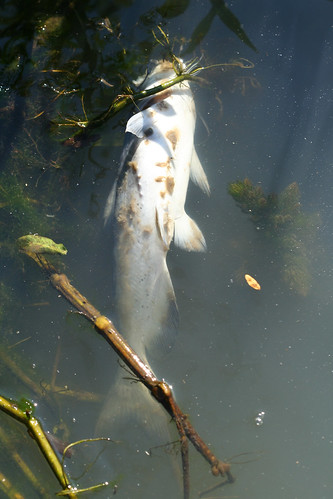
This is a fake magazine cover...I think but it was posted to a real Flickr group called Dead Fish which features pictures of, well, dead fish.

I actually like the flickr group. Fish skeletons are quite attractive as one of my colleagues can attest. In fact she turned me on to Flickr's Dead Fish group when I was looking for a place to post this picture of a dead fish.

milkfish

Saturday, September 12, 2009

A lesson from my plants

Here are three plants from my collection:

Plant number 1


Plant number 2


and finally...

Plant number 3


Which are cacti?

A little more information. At least one is a cactus.

The first plant grows in warm semi arid regions in South America. Some members of this group of plants get to be mid sized trees but most are shrubby.

The second plant has reduced leaves that function as thorns and it is found in deserts in the SW United States and Mexico.

The third plant lives in the jungles of Southern Mexico and into Central America.

All three plants have very similar looking and distinctive complex flowers, all organized in the same basic way.

So which are cacti? How do you know?

Saturday, March 14, 2009

Some people...

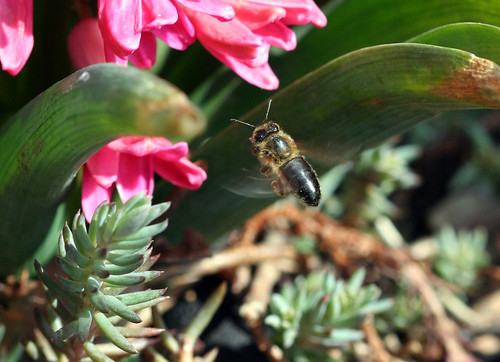
...watch for the first robin of Spring. What do I watch for? Obviously, the first...

First Bee...

Wednesday, February 11, 2009

Happy Birthday Mr. Darwin!

We love birthdays and anniversaries , especially ones that end in zero. This year there are two such numbers related to Charles Darwin-200 years since his birth and 150 years since publication of Origin of Species. Of course there is all sorts of commentary and there should be. After all Darwin's way of looking at the world really did revolutionize biology and society as a whole.

What was it really that Darwin did that was so great? After all he wasn't the first person to speculate that evolution happens, or even to propose how it might happen. Maybe he was just the right person at the right time to be remembered. But I think there is more. Perhaps the best way to answer the question from my perspective is to briefly contrast Charles Darwin with Jean Louis Agassiz. Agassiz was one of the most popular scientists of the 19th century, especially in biology, Harvard Professor, did lots of important work on fossils and glaciation. Yet he never accepted evolution.

I encountered Agassiz in Edward Lurie's biography, Louis Agassiz: A Life in Science. Lurie observed, as I recall, that Agassiz was a proponent of the notion that the geological features of the Earth were molded mainly by a series of catastrophic events and that that the distribution of species could be best explained by a series of creation events. As new data about geology and the distribution of species came out-Agassiz would simply postulate a new catastrophe or a new creation event. So the data are explained.

Darwin was different. Not only did he synthesize masses of data to support his ideas, but he confronted the weaknesses in his ideas head on. After all, Darwin knew that contradictions between observation and theory are not to be feared but provide new opportunities to learn by empirical means what makes the universe work. Agassiz was an accomplished scientist as well and probably understood this idea as well. The difference is that Agassiz did not understand the universality of the principle that contradictions provide new opportunities in all spheres of science, and, I argue, life as well.

So happy birthday Mr. Darwin and here's to biologists today who see contradiction as something not to be feared, or glossed over with rhetorical tricks, but as opportunity for understanding.

Monday, January 12, 2009

Save the Sea Kittens?

The People for the Ethical Treatment of Animals(PETA) has a new campaign, this time against fishing complete with a splashy new web site designed to hook unsuspecting visitors. The site claims that:

"People don't seem to like fish. They're slithery and slimy, and they have eyes on either side of their pointy little heads—which is weird, to say the least. Plus, the small ones nibble at your feet when you're swimming, and the big ones—well, the big ones will bite your face off if Jaws is anything to go by. "

Hence the make over. The site has places for "Sea Kitten stories" , petitions urging the US Fish and Wildlife Service to stop promoting fishing, oh and if you want you can even buy a Sea Kitten Hoodie-imagine the fashion statement that would make at school or in the neighborhood! Another page makes the PETA case a little bit more directly noting quite properly that fish are quite smart, capable sophisticated sensory and cognitive feats and therefore (their leap of logic not mine) ought to not be subject to the cruelty of fishing.

Now the notion that animals are cognitively aware at least of the present does give some moral weight to the notion that we ought to minimize human caused animal suffering and that animals ought to be respected for what they are, but really PETA's effort is a blatant attempt to exploit the healthy sense of empathy that most people have about animals rather than encouraging people to see animals (including ourselves) in a balanced way.

Also Leopold in one of his Sand County Almanac essays argued that in order for people to understand the value of conservation and "The Land Ethic", they have to have an emotional connection to the land. I agree but I don't think that this misplaced empathy is what he had in mind.

By the way, there is a very interesting essay on the Ethics of Eating Animals in Michael Pollan's recent book, Omnivore's Dilemma which tackles animal rights in a more balanced way. Pollan concludes that:

"To give up eating animals is to give up on these places(nota bene: where animals live) as human habitat , unless of course we are willing to make complete our dependence on a highly industrialized food chain."

Now that is a good omnivore attitude!

I recommend Pollan's book as a corrective to anyone who might otherwise be susceptible to the simplistc arguments that PETA foists an all us kitten lovers.

Full disclosure: I have 2 Kittens; well they used to be Kittens. One of them has eaten fish the other one wouldn't have the first notion what to do with a fish. I have been fishing, in fact for catfish. And yes this omnivore did eat them.

Tuesday, November 11, 2008

A Great Time for Genetics

This is a great time to be involved in genetics because there is so much change happening in all areas of genetics from real basic stuff such as the nature of the gene to how genes figure into evolution.

There is a great series of articles in the New York Times science section that you ought to look at to get some sense of the excitement today in genetics.

The first article by Carl Zimmer looks at the genome, all the DNA found in our chromosomes. The article focuses not so much on the classical protein coding genes that every one thinks about the rather the 99% of the DNA in our cells, that is not well understood. The article also delves in to what do we mean by a gene any way? The concept started with Mendel who not knowing about DNA called genes factors. During most of the 20th century we taught that genes code for proteins but now we understand that genes are a lot weirder than the cut and dry protein coding segments of DNA we thought they were.

The next article by Andrew Pollack looks at RNA and the many roles of this molecule in genetics. We used to think that there were three types of RNA, ribosomal, transcript and messenger but now we understand that there are other types of RNA that are involved in the regulation of genes and their expression. Some of these RNA’s may revolutionize the way we treat certain diseases.

The next article in the series by Benedict Carey looks at new hypothesis about mental illness which says that certain types of mental illness might result in the conflict of genes from a person’s parents.

The notion that genes may be in conflict with one another may seem odd, but here is an example. We know that there are genetic elements that make extra copies of themselves in the genome or bias the results of meiosis so that more of them get passed on to the offspring even at the expense of the fitness of the individual organism. It turns out that in response to these sorts of “selfish elements”, other genes suppress the activity of the “selfish genes” . Gene conflict also plays out in the male parent’s vs the female parent’s genes during development and the article discusses an interesting example of that.

The notion of gene conflict in an evolutionary sense is well established for certain type of genes but if this idea is true it would mean that certain types of mental illness are not so much due to what genes you have but which genes “win” the gene conflict and are expressed.

These articles may seem quite different but they all have a couple of common threads. First of all they illustrate the dynamic nature of science and how scientists rather than wanting to defend simplistic views of science are constantly challenging established science as new empirical evidence becomes available. Second these articles each in their own way get at the limitations of basic concepts and levels of analysis used in science. In the first article, the gene concept, which started out with a gene as an indivisible factor like a bead on a string, has morphed into a series of somewhat different concepts to the point where you can’t always tell where one gene begins and another end.

The second article lays waste to the idea that everything in the cell is controlled somehow by the DNA working with proteins. RNA’s also are involved in determining which genes are expressed and which are not. So here our original understanding of RNA again has been altered due to some very interesting discoveries, some of which were quite accidental.

The 3rd article takes the role of genes in mental illness and for that matter lots of other situations a step beyond what genes are present as being important, but to a view point that within an individual genes may be in “conflict”, so our notions of genotype (typically defined as the specific combination of genes an individual has) turn out to be way too simplified. Not only that the notion of gene conflict introduces a whole shadow world with in an individual organism so that the individual become like a house divided…divided by an evolutionary conflict between the organism’s own genes.

So check these articles out and let me know what you think.

Wednesday, October 15, 2008

Sometimes it's all about "marketing"

I am no fan of fights as any one who knows me understands. But I must confess to watching Fight Club on TV. Jurassic Fight Club on the History Channel that is. If you are not in the loop Jurassic fight club pits big predators from the past against each other using fossil evidence to create what the creators think are plausible scenarios, say between a giant megashark and an early whale-OK so the program strays a bit from the Jurassic.

Some of the scenarios are a bit implausible and anthropomorphic (There isn't a fancy word to describe the attribution of the thought process of 25 year old males who wear grimy backwards baseball caps into fancy restaurant to other organisms) but the program gives a really nice introduction to how scientists make inferences from the fossil record and the tools they use.

So I recommend this series if you are curious about just what scientists can learn from the fossil record-it turns out to be much more than you might think. For instance it is quite possible to match up teeth marks with teeth much like human forensic experts match knife blades to cuts in flesh or bone and I just hate to bust the bubble of any young earth creationist types the evidence does NOT suggest that T. rex was ever a vegetarian.

The fight approach to organism interactions and evolution goes back at least to the 19th century to Darwin and the early evolutionists who viewed evolution and natural selection often in terms of competition-much of this was probably as much due to Darwin's early adherents as much to Darwin. Be that as it may, the metaphor still holds sway in the popular psyche even if scientists have a much more sophisticated understanding of how evolution operates including the ability of evolution to lead to cooperative behavior and even the moral sense displayed by humans in some of our finer moments.

At any rate I was reminded of the marketing aspect of all this by a headline on the BBC website today that screams out:

Two of the UK's worst aquatic invasive species are set to meet.

Scientists believe that the ranges of the plague-carrying non-native crayfish and the fierce Chinese mitten crab are beginning to overlap.

Well of course I had to check this out..plague carrying crayfish and fierce Chinese mitten crab. Wow! And the article even has a picture of both the beasties in fight mode and a video about these alien thugs preparing to meet. While the plague of course is not the Black Plague but rather a disease that infects native crayfish in Britain, the BBC coverage does correctly highlight the threat posed by these two species. And the question about what will happen when these non native species to Britain meet is an important one. So I guess that I can't really fault the hype involved in getting people to read about science.

Hey it even worked for me and I don't even own a baseball cap, grimy or not.


The Crayfish mitten crab video complete with menacing music is here: