Showing posts with label science. Show all posts

Thursday, March 01, 2012

Intelligent Design Monkey Business-again.

There is an interesting article in this month's Chronicle of Higher Education about intelligent design. Apparently some of ID's leading luminaries held a conference at Cornell University, my alma mater, and conned convinced Springer, a major science publishing house, to publish the conference papers as a volume called Biological Information, New Perspectives.

Apparently Springer posted a web page advertising this forth coming book on its web site but it was quickly pulled when science bloggers such as Nick Matzke over at Panda's Thumb discovered this page and posted about it here.

Springer immediately pulled the web page advertising the ID volume deciding that maybe it needs more complete peer review. Apparently, even as noted by this sympathetic review of the conference, participants were told to tone down their religious perspectives so that the conference would be more scientific.

In an update on Panda's Thumb more details have surfaced. First the conference was not well attended. There were 27 or so attendees and that apparently included the presenters.  Second the conference really had nothing to do with Cornell officially but was merely held in the auditorium at Cornell's fine hotel school. This auditorium is rented to the public and that is what happened here.  The conference apparently was not publicized and indeed was held in that in between time before summer semester. To be fair to the conference organizers, that time of year is a wonderful year to be in Ithaca as I spent four delightful summers working there as an undergrad.

That said, one wonders if the University is too happy about having its reputation besmirched by implied association with this conference.

http://www.insidehighered.com/news/2012/03/01/book-intelligent-design-proponents-upsets-scientists

http://pandasthumb.org/archives/2012/02/springer-gets-s.html

http://pandasthumb.org/archives/2012/02/update-on-sprin.html

Monday, October 17, 2011

I remember amber

I remember amber by pdecell
I remember amber, a photo by pdecell on Flickr.
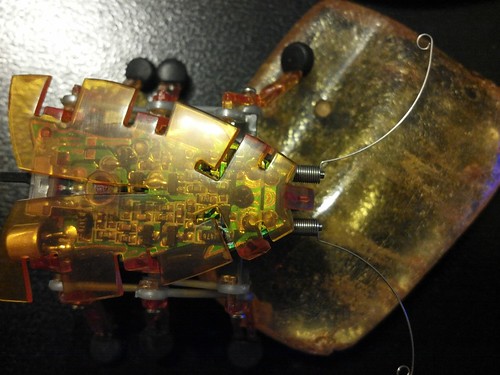
I have this robot insect and a piece of amber. The rest is obvious. The amber by the way has the remains of termites embedded in it. The person who sold the piece to me said they were ants which I think would have been more exciting, perhaps because I know more about ants than termites. But it is still exciting to realize that complex social behaviors date to the Cretaceous period 145 million years ago.

Tuesday, April 05, 2011

Science From Multiple World Views?

Recently I stumbled upon a small publisher of home school materials called Gravitas Publications. This publisher's main product is called Real Science 4 Kids by Dr. Rebecca Keller. I have no expertise in home school curricula, and from what I have seen some aspects of her approach seem sensible.

What bothers me is her claim that science can be taught from the point of view of multiple world views in a strictly neutral sort of way.

She writes:

"Yes! Real science doesn’t choose sides. So when teaching science, it’s important that the lessons let kids explore all sides. Otherwise, choosing one side can get in the way of understanding the real science. Darwinism, creationism, intelligent design theory, and all the other “isms” are simply paradigms (or “lenses”) through which science is viewed. The “-isms” are philosophies based on perceptions for how science is interpreted. Students need to learn how “-isms” play a role in science."

Ok, science doesn't choose sides in that is ideologically neutral- there is no conservative science, or Christian science, or Buddhist science. There ideally is just science. And she is right- our world view does affect how we interpret science. But is science really neutral in terms of the world view it admits?

Personally I think not. For example I don't see much support in science for the notion that the Universe or the Earth is say 10,000 years old or that the goal of a liquid is to seek its lowest level, or that magic is real. At the very least science since it is empirical forces scientific explanations and tests of scientific ideas to be mechanistic and transparent.

At any rate, check out Dr. Keller's video discussing the issue of multiple world views and see what you think:

Saturday, January 08, 2011

A New Word.

Picked up a new word today courtesy of an article in Scientific American on Freeman Dyson. The word is "bunkrapt." The neologism coined by Peter Medawar in the 1980's means, to according to the article, to be "infatuated with bunk." So I guess it is from bunk + rapture. I can't wait to use this on my favorite intelligent design hipster or anti-vaccine fanatic.

The article's author John Horgan notes referring to what he sees as some of the wacky beliefs of Freeman Dyson that:

"The gleeful rebel Dyson, it seems to me, embodies our bunkrapt era, when the delineation between knowledge and pseudo-knowledge is becoming increasingly blurred; genuine authorities are mistaken for hucksters and vice versa; and we all believe whatever damn thing we want to believe."

Monday, January 03, 2011

Oops that's not right!

In my distant past I was a research assistant working with a scientist who had a whole bunch of pair wise correlations between variables in a very large data set. The researcher found some interesting correlations between some of these variables and complained that the statistician involved with the research said that the correlations were not significant even though looked at in isolation they were significant. I had to agree with the statistician and fortunately was able to convince my boss that the statistician was indeed correct here. My reasoning was basically by analogy-if you flip 100 coins you expect to find on average 50 heads and 50 tails and your results should vary around that by chance. Further, every once in a while, you expect to find say 20 heads and 50 tails just by chance and you would not get excited about that. In the same way if you have a slew of uncorrelated variables by chance you can get some significant correlations.

Scientists love statistically "significant" results but this last year a very interesting article titled "The Truth Wears Off" appeared in the New Yorker looking at a disturbingly common pattern in science, called the decline effect. Often, especially with complex phenomena initial experimental results are highly significant , but then with replication the results either are not so pronounced or disappear entirely. The results cannot be replicated. The article's author Jonah Lehrer gives a wide range of examples from both basic and applied science and lists a number of reasons why this phenomenon happens.

Some of the reasons discussed are bias toward positive results, include regression toward the mean, and publication bias, none of which by themselves explain what is going on. The most likely culprit seems to be selective reporting and this has actually itself been tested by a biologist by the name of Richard Palmer. Lehrer says the following about Palmer's investigation:

"Palmer’s most convincing evidence relies on a statistical tool known as a funnel graph. When a large number of studies have been done on a single subject, the data should follow a pattern: studies with a large sample size should all cluster around a common value—the true result—whereas those with a smaller sample size should exhibit a random scattering, since they’re subject to greater sampling error. This pattern gives the graph its name, since the distribution resembles a funnel....after Palmer plotted every study of fluctuating asymmetry, he noticed that the distribution of results with smaller sample sizes wasn’t random at all but instead skewed heavily toward positive results."

Palmer's results suggest that reporting bias is everywhere in science and Palmer concludes that:

“We cannot escape the troubling conclusion that some—perhaps many—cherished generalities are at best exaggerated in their biological significance and at worst a collective illusion nurtured by strong a-priori beliefs often repeated.”

The article gives a range of disturbing examples from a wide range of disciplines and gloomily concludes that:

"Such anomalies demonstrate the slipperiness of empiricism. Although many scientific ideas generate conflicting results and suffer from falling effect sizes, they continue to get cited in the textbooks and drive standard medical practice. Why? Because these ideas seem true. Because they make sense. Because we can’t bear to let them go. And this is why the decline effect is so troubling. Not because it reveals the human fallibility of science, in which data are tweaked and beliefs shape perceptions."

So what's to be done? From my perspective there are several things, some of which are discussed int he article. First of all scientists have to avoid what the article terms significance chasing-getting excited about seemingly significant correlations as my old boss did. Related to that, scientists need to be sure that they are indeed using appropriately conservative tests, that is tests that minimize the chance that an incorrect hypothesis will be accepted. Data needs to be open and available for scrutiny and experimental controls carefully laid out. When I teach, one one thing I tell my students is that the hypothesis and the experimental design has to be worked out in advance of testing the hypothesis including the sample sizes.

Maybe we forget- and don't properly train our students to remember- that a hypothesis is just that - it is a guess, perhaps informed by theory but it is still a guess and non significant results are still meaningful. Of course it would help if funding agencies by they governmental or private would remember that as well!


http://www.newyorker.com/reporting/2010/12/13/101213fa_fact_lehrer

Saturday, December 18, 2010

Religious Discrimination or Mere Whining?

An astronomer is suing the University of Kentucky alleging that he was refused a position because of his religious beliefs. Martin Gaskell was supposedly the top candidate for a new observatory position but didn't get it. Dr. Gaskell is an evangelical who has written and lectured on science and his faith. Apparently this got people nervous that his religious beliefs might influence his science.

This statement in particular from an essay Dr. Gaskell wrote seems to have caught people's attention:

"The main controversy has been between people at the two extremes (young earth creationists and humanistic evolutionists). “Creationists” attack the science of “evolutionists”. I believe that this sort of attack is very bad both scientifically and theologically. The “scientific” explanations offered by “creationists” are mostly very poor science and I believe this sort of thing actually hinders some (many?) scientists becoming Christians. It is true that there are significant scientific problems in evolutionary theory (a good thing or else many biologists and geologists would be out of a job) and that these problems are bigger than is usually made out in introductory geology/biology courses, but the real problem with humanistic evolution is in the unwarranted atheistic assumptions and extrapolations. It is the latter that “creationists” should really be attacking (many books do, in fact, attack these unwarranted assumptions and extrapolations)."

However on the surface I am not sure his views are that much different from theistic evolutionists such as Ken Miller. But looking more closely I am bothered by his inclusion in a positive light of groups like "Leadership U" which try to push ... "Intelligent Design".

Also as noted here his attorney refers to Gaskell as an "openly Christian man". Seems like a clever appeal for sympathy in spirit of diversity promoting acceptance of GLBT people. If so this strategy is not going to garner much support from me. I have seen attempts to use this strategy by whiny conservatives whose only motivation is to use the rhetoric of diversity to silence discussion of diversity.

Related Links:

http://www.nytimes.com/2010/12/19/us/19kentucky.html

http://www.examiner.com/creationism-in-national/astronomer-alleges-anti-religious-discrimination-by-university

http://www.courier-journal.com/article/20101210/NEWS01/312110011/Job+candidate+sues+UK++claiming+religion+cost+him+the+post

http://blogs.sciencemag.org/sciencecareers/2010/12/should-a-scient.html

Tuesday, November 16, 2010

Ah for the good old days!

...when convictions were convictions and martyrs were martyrs. Apparently William Dembski, has had to recant some of his moderate views on creation. In his latest book, End Of Christianity, he had the temerity to admit that he believes that scientists ARE right-the Universe really IS around 14 billion years old and that "the Flood" was NOT world wide. I guess that didn't set well with his overlords (I mean bosses) at Southwestern Baptist Theological Seminary. According to Michael Zimmerman writing in the Huffington Post, Dembski was called on the carpet for his writings. Since the inquisition is long gone, presumably his bosses used less drastic means than hot pokers or racks to get him to recant. Maybe they water boarded him- I don't know.

At any rate Dembski has at least partly recanted claiming that his statement about the flood NOT being universal was based on incomplete reflection:

"Before I write on this topic ( the Flood) again, I have much exegetical,
historical, and theological work to do. In any case, not only Genesis 6–9 but also
Jesus in Matthew 24 and Peter in Second Peter seem clearly to teach that the
Flood was universal. As a biblical inerrantist, I believe that what the Bible teaches
is true and bow to the text, including its teaching about the Flood and its
universality."

quoted in:

http://www.baptisttheology.org/documents/AReplytoTomNettlesReviewofDembskisTheEndofChristianity.pdf

Intelligent design advocates have long claimed that their beliefs about intelligent design are NOT Biblically motivated but I wonder how we are to take an advocate of intelligent design placing the Bible above empirical data.

To be fair, Dembski does not entirely recant but argues:

"My book The End of Christianity is a work of speculative theology. It
assumes that the earth and universe are old and, given that assumption, attempts
to answer how the Fall of humanity could be responsible for natural evil, such as
animal suffering. Since, on the assumption of an old earth, animal suffering
precedes the arrival of humans, the challenge is to explain how the effect (natural
evil) can temporally precede the cause (human sin and the Fall). My solution is to
argue that just as the effects of salvation at the Cross of Christ reach both forward
in time (saving contemporary Christians) and backward (saving the Old
Testament saints), so the effects of the Fall reach forward in time as well as
backward. What makes my argument work is the ability of God to arrange events
at one time to anticipate events at a later time."

OK so Dembski argues that the Fall was an actual event whose affects rippled both into the present and also into the past. So I guess all those veggie eating dinosaurs in the Creation Science museum mysteriously got transformed into evil T. rexes.

Speculative theology indeed!

Saturday, September 25, 2010

Jupiter and Uranus

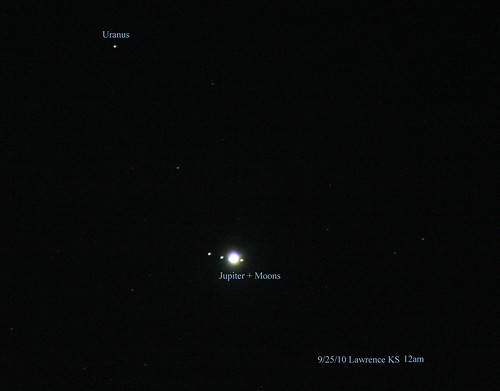
The 23rd of September was the harvest moon, which was pretty spectacular but I was more interested in the close approach of Jupiter and Uranus being easy to spot. Here is my first attempt to get a picture of Jupiter...and as an added bonus, Uranus. Click through to my Flickr site to see the notes.

Jupiter

I don't have a tracker-just my Canon rebel and my not so hot 300mm telephoto lens, so the trick is to get a long enough exposure to render the planets and Jupiter's 3 visible moons and not get any streaking from the Earth's rotation. Also the moon was just off picture at the top.

Thursday night was rainy but last night and early this morning I went out again and got this shot:

jupiter2 copy

The moon was much further in the sky from Jupiter so I didn't have to do any post processing to this image. Also the moon's are much sharper.

Of course I didn't ignore our moon but full moons don't make good shots if you are interested in lunar detail-but I did have fun taking pictures of the wonderful shadows cast by our moon on the 23rd.

By the light

Note there was enough light to get color from the plants and pots.

Monday, November 02, 2009

Coalescence

Even everyday happenings are full of surprises when seen on a different scale of length or time or both and this video of falling water drops coalescing with the surface of water shows this very nicely. There are two effects going on here surface tension and more surprisingly to me a thin film of air. Enjoy!


Tip of the antennae to Sarah S for the find.

Wednesday, February 11, 2009

Happy Birthday Mr. Darwin!

We love birthdays and anniversaries , especially ones that end in zero. This year there are two such numbers related to Charles Darwin-200 years since his birth and 150 years since publication of Origin of Species. Of course there is all sorts of commentary and there should be. After all Darwin's way of looking at the world really did revolutionize biology and society as a whole.

What was it really that Darwin did that was so great? After all he wasn't the first person to speculate that evolution happens, or even to propose how it might happen. Maybe he was just the right person at the right time to be remembered. But I think there is more. Perhaps the best way to answer the question from my perspective is to briefly contrast Charles Darwin with Jean Louis Agassiz. Agassiz was one of the most popular scientists of the 19th century, especially in biology, Harvard Professor, did lots of important work on fossils and glaciation. Yet he never accepted evolution.

I encountered Agassiz in Edward Lurie's biography, Louis Agassiz: A Life in Science. Lurie observed, as I recall, that Agassiz was a proponent of the notion that the geological features of the Earth were molded mainly by a series of catastrophic events and that that the distribution of species could be best explained by a series of creation events. As new data about geology and the distribution of species came out-Agassiz would simply postulate a new catastrophe or a new creation event. So the data are explained.

Darwin was different. Not only did he synthesize masses of data to support his ideas, but he confronted the weaknesses in his ideas head on. After all, Darwin knew that contradictions between observation and theory are not to be feared but provide new opportunities to learn by empirical means what makes the universe work. Agassiz was an accomplished scientist as well and probably understood this idea as well. The difference is that Agassiz did not understand the universality of the principle that contradictions provide new opportunities in all spheres of science, and, I argue, life as well.

So happy birthday Mr. Darwin and here's to biologists today who see contradiction as something not to be feared, or glossed over with rhetorical tricks, but as opportunity for understanding.

Tuesday, November 11, 2008

A Great Time for Genetics

This is a great time to be involved in genetics because there is so much change happening in all areas of genetics from real basic stuff such as the nature of the gene to how genes figure into evolution.

There is a great series of articles in the New York Times science section that you ought to look at to get some sense of the excitement today in genetics.

The first article by Carl Zimmer looks at the genome, all the DNA found in our chromosomes. The article focuses not so much on the classical protein coding genes that every one thinks about the rather the 99% of the DNA in our cells, that is not well understood. The article also delves in to what do we mean by a gene any way? The concept started with Mendel who not knowing about DNA called genes factors. During most of the 20th century we taught that genes code for proteins but now we understand that genes are a lot weirder than the cut and dry protein coding segments of DNA we thought they were.

The next article by Andrew Pollack looks at RNA and the many roles of this molecule in genetics. We used to think that there were three types of RNA, ribosomal, transcript and messenger but now we understand that there are other types of RNA that are involved in the regulation of genes and their expression. Some of these RNA’s may revolutionize the way we treat certain diseases.

The next article in the series by Benedict Carey looks at new hypothesis about mental illness which says that certain types of mental illness might result in the conflict of genes from a person’s parents.

The notion that genes may be in conflict with one another may seem odd, but here is an example. We know that there are genetic elements that make extra copies of themselves in the genome or bias the results of meiosis so that more of them get passed on to the offspring even at the expense of the fitness of the individual organism. It turns out that in response to these sorts of “selfish elements”, other genes suppress the activity of the “selfish genes” . Gene conflict also plays out in the male parent’s vs the female parent’s genes during development and the article discusses an interesting example of that.

The notion of gene conflict in an evolutionary sense is well established for certain type of genes but if this idea is true it would mean that certain types of mental illness are not so much due to what genes you have but which genes “win” the gene conflict and are expressed.

These articles may seem quite different but they all have a couple of common threads. First of all they illustrate the dynamic nature of science and how scientists rather than wanting to defend simplistic views of science are constantly challenging established science as new empirical evidence becomes available. Second these articles each in their own way get at the limitations of basic concepts and levels of analysis used in science. In the first article, the gene concept, which started out with a gene as an indivisible factor like a bead on a string, has morphed into a series of somewhat different concepts to the point where you can’t always tell where one gene begins and another end.

The second article lays waste to the idea that everything in the cell is controlled somehow by the DNA working with proteins. RNA’s also are involved in determining which genes are expressed and which are not. So here our original understanding of RNA again has been altered due to some very interesting discoveries, some of which were quite accidental.

The 3rd article takes the role of genes in mental illness and for that matter lots of other situations a step beyond what genes are present as being important, but to a view point that within an individual genes may be in “conflict”, so our notions of genotype (typically defined as the specific combination of genes an individual has) turn out to be way too simplified. Not only that the notion of gene conflict introduces a whole shadow world with in an individual organism so that the individual become like a house divided…divided by an evolutionary conflict between the organism’s own genes.

So check these articles out and let me know what you think.

Wednesday, October 15, 2008

Sometimes it's all about "marketing"

I am no fan of fights as any one who knows me understands. But I must confess to watching Fight Club on TV. Jurassic Fight Club on the History Channel that is. If you are not in the loop Jurassic fight club pits big predators from the past against each other using fossil evidence to create what the creators think are plausible scenarios, say between a giant megashark and an early whale-OK so the program strays a bit from the Jurassic.

Some of the scenarios are a bit implausible and anthropomorphic (There isn't a fancy word to describe the attribution of the thought process of 25 year old males who wear grimy backwards baseball caps into fancy restaurant to other organisms) but the program gives a really nice introduction to how scientists make inferences from the fossil record and the tools they use.

So I recommend this series if you are curious about just what scientists can learn from the fossil record-it turns out to be much more than you might think. For instance it is quite possible to match up teeth marks with teeth much like human forensic experts match knife blades to cuts in flesh or bone and I just hate to bust the bubble of any young earth creationist types the evidence does NOT suggest that T. rex was ever a vegetarian.

The fight approach to organism interactions and evolution goes back at least to the 19th century to Darwin and the early evolutionists who viewed evolution and natural selection often in terms of competition-much of this was probably as much due to Darwin's early adherents as much to Darwin. Be that as it may, the metaphor still holds sway in the popular psyche even if scientists have a much more sophisticated understanding of how evolution operates including the ability of evolution to lead to cooperative behavior and even the moral sense displayed by humans in some of our finer moments.

At any rate I was reminded of the marketing aspect of all this by a headline on the BBC website today that screams out:

Two of the UK's worst aquatic invasive species are set to meet.

Scientists believe that the ranges of the plague-carrying non-native crayfish and the fierce Chinese mitten crab are beginning to overlap.

Well of course I had to check this out..plague carrying crayfish and fierce Chinese mitten crab. Wow! And the article even has a picture of both the beasties in fight mode and a video about these alien thugs preparing to meet. While the plague of course is not the Black Plague but rather a disease that infects native crayfish in Britain, the BBC coverage does correctly highlight the threat posed by these two species. And the question about what will happen when these non native species to Britain meet is an important one. So I guess that I can't really fault the hype involved in getting people to read about science.

Hey it even worked for me and I don't even own a baseball cap, grimy or not.


The Crayfish mitten crab video complete with menacing music is here:

Friday, August 29, 2008

Well there goes McCain...

I see that John McCain has picked Alaska's governor Palin as his running mate. Intriguing choice since McCain likes to position himself as a maverick. But science wise the choice is a bit flaky, Palin seems to have bought into the beguiling argument that schools should teach both creationism and evolution. She is quoted here in the Anchorage Daily News:

"Teach both. You know, don't be afraid of information. Healthy debate is so important, and it's so valuable in our schools. I am a proponent of teaching both."

Later on in the same interview she did back track a bit and qualified her remarks saying:

"I don't think there should be a prohibition against debate if it comes up in class. It doesn't have to be part of the curriculum."

Of course the state Republican platform according to the same article says that:

"We support giving Creation Science equal representation with other theories of the origin of life. If evolution is taught, it should be presented as only a theory."

And that merely echos the common misunderstanding people have about the meaning of the word theory in science.

Clearly though regardless of what she thinks about creationism and its cheap suit version intelligent design, she doesn't understand much about science. Too bad because I honestly felt this was an election where I could "kick the tires" to choose between two great tickets. But John McCain certainly hasn't helped himself here among moderates and certainly hasn't boosted my opinion of his science policy. If he wanted to go the conservative evangelical route he should picked Huckabee.

To give Palin her due she doesn't seem to have the sort of skepticsm about climate change that one might expect. But then again considering how rapidly Arctic climate regimes are being altered by global warming, she probably wouldn't be able to survive politically unless she supported programs to help her state cope with warming.

Tuesday, August 26, 2008

Where's the Food?

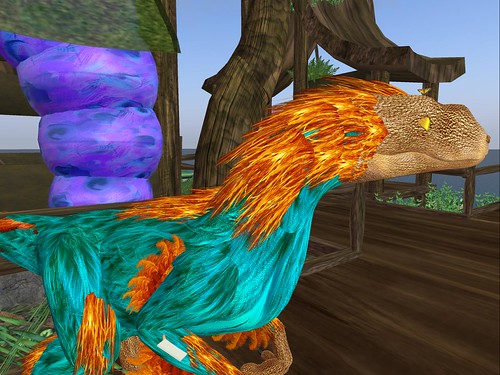
Me in Second Life as Velociraptor:

Where's the food?

See my Second Life Biology blog for more details.
http://slbiology.blogspot.com/2008/08/visit-to-dinosaur-park.html

Sunday, August 10, 2008

Science Friday in Second Life!

I am not much of an online chatter. I've tried chat rooms for instance and found them too confusing for my addled brain and in Second Life I have been to openings and parties and found them difficult to handle. But then I am sort of a solitary type whether in first or second life.

But I decided to look for some SL event Friday when I was spending a ton of time in SL rather than working on my Syllabuses (or should that be Syllabi?). So I decided to visit Science Friday, which if you are a listener, you know Sci Fri is streamed in to SL and to the Science Friday site and during which the host of Science Friday is in World.

And I was pleasantly surprised at how wonderful the communal experience of listening in SL with a group was compared to just listening on the radio.

The avatars actually chatted (mainly texting) during the program's audio stream. I should point out that the host Ira Flatow was in World but not his guests. What I found though was that first of all the chat was surprisingly on topic. Second of all, though I did not contribute a whole lot, the chat in parallel with listening to the audio stream really forced me to pay closer attention to the broadcast than I otherwise might have. And this is in spite of the texting going on constantly during the broadcast.

Granted, the audience appeared to be really interested in the topics, but it would be interesting to test listener retention of material when just listening while in SL versus having real time messaging and social interaction while the material is being presented.

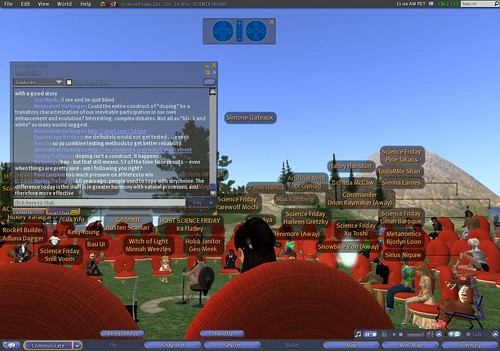
Here are some shots of the session from my Flickr stream:

Science Friday in Second Life

This shows the audience..thank god for camera controls so that even though I was sitting in the audience I could effectively look at the audience including myself.

And next a shot of the Ira's avatar...

Science Friday in Second Life

Now if only I could get an autograph.

If you are a Second Life member and have SL on your machine the Science Friday Site SLurl is
http://slurl.com/secondlife/Science%20Friday/128/128/2

Not much to see in the Science Friday sim itself but right near by is all kinds of neat science stuff so explore around! More on some of the new science stuff later...

To get you started visit Science School at http://slurl.com/secondlife/Science%20School/128/128/2

Wednesday, August 06, 2008

Some Petty Sniping

Tonight I was prowling around the web and stumbled across the American Council on Science and Health's website (http://www.acsh.org/) which is a non profit that describes itself as:

“...a consumer education consortium concerned with issues related to food, nutrition, chemicals, pharmaceuticals, lifestyle, the environment and health.”

Their basic viewpoint seems to be don't sweat the small stuff in terms of health risks but keep focused on the big stuff and that is reflected in their risk assessment website (http://riskometer.org/index.html) which indeed is lot's of fun.

What caught my eye is a bit of sniping going on in the science policy advocacy world. On the main ACSH page is a link CSPI vs ASCH (http://www.acsh.org/about/pageID.86/default.asp). CSPI is the Center for Science in the Public Interest (http://www.cspinet.org/new/index.html). It turns out that CSPI attacked the credibility of ACSH in a press release. The press release deals with a very important problem in evaluating credibility science reporting, especially alleged scientific information put out by advocacy groups- namely who do these groups really represent?

Here is what CSPI says about ACSH in its news release(http://www.cspinet.org/integrity/press/200407071.html):

“...news accounts often fail to identify the funding sources of ostensibly independent nonprofit organizations that are quoted on health and medical issues. For instance, a real group called the American Council on Science and Health is largely funded by chemical, food, and agribusiness companies and is widely quoted downplaying various risks to public health or discrediting studies indicating risks to health. In the pages of The New York Times it is sometimes blandly cited as a "science advocacy group," a "private health education group," or a "group that describes itself as 400 doctors and scientists who release position statements on science and the environment." Elsewhere, the Times more helpfully has described the group as a "consumer foundation in Manhattan that is in part financed by industry," or as a group that is "financed in part by the food industry. “

Well ACSH of course fired back:

“ACSH has a long history of going where the science takes us, even when that science is counter to the interest of its funders.

For instance, ACSH regularly criticizes industries who are guilty of

· making unscientific and overstated health claims
· promoting dangerous natural supplements
· failing to tell the truth about scientific issues, as in the case of industry's failure to defend the safety of genetically modified foods.

Of course, we are known for pointing out the dangers of tobacco in all its forms: Smoking is the #1 public health threat in the world (you wouldn't know this from listening to CSPI). But it's not just tobacco. ACSH regularly criticizes all of those responsible for distorting the truth about important public health issues -- including those who demonize specific foods as causes of obesity, a favorite tactic of CSPI.”

Ouch.

And ACSH then goes on to note:

“We encourage reporters and the public to consider sources of bias beyond corporate funding alone. For instance, from which foundations does CSPI gets its money? Do reporters ask about their project-specific funding from left-wing foundations whose stated goals are to increase governmental regulation and take away choices from consumers?”

Of course if ASCH were so concerned about this maybe they ought to take the lead and be more transparent in how they report their funding sources on their web site. About all I can find in terms of funding from their annual report (http://www.acsh.org/docLib/20070313_2007AR_final.pdf) is that ASCH received about 2,879 million dollars in revenue, 2,470 of which comes from funders as opposed to memberships and sales. It might be nice to have a better idea who those funders are.

How about CSPI? CSPI has a full page devoted to its funding sources (http://www.cspinet.org/about/funding.html) and states:

“CSPI is primarily funded by the 900,000 subscribers to its Nutrition Action Healthletter and individual donors. Private foundation grants make up approximately 5% to 10% of CSPI's annual revenue of $17 million. Nutrition Action Healthletter accepts no advertising, and CSPI accepts no corporate funds or government grants. CSPI's audited financial statements and its IRS Form 990, both of which conform to Generally Accepted Accounting Principles established by the American Institute of Certified Public Accountants, are available for inspection. CSPI also maintains a strict conflict of interest policy for its staff and board members. CSPI extends its sincere gratitude to those foundations and to the thousands of individuals who provide support for its advocacy programs. “

The list of foundations hardly seems to be left wing, so I wish ASCH would have been more specific about which organizations have a goal of increasing government regulation. Clearly these two organizations ASCH and CSPI have different political slants, different funding sources and play to very different audiences. I wish reporters ask more questions about funding sources, but advocacy groups of all stripes ought to take the lead and be open about where they get their funding. Personally I believe ASCH when it claims to be relatively independent of their funding sources, and CSPI implicitly makes the same claim, and they are probably correct in doing so.

But from my perspective neither organization ought to be engaged in the sort of over the top sniping of the other and stick to the important health issues at hand. So a pox on both their houses.

In the interest of full disclosure, I am a real person who receives no funding from industry or wacko private foundations on the left or the right and I occasionally eat hot dogs, foods with trans fats and enjoy taking risks by eating genetically modified corn and using a cell phone though I rarely use pesticides and believe the case for global warming is pretty solid. Oh yes, I I'm pretty liberal and a registered Democrat.


Sunday, July 13, 2008

A Script Generator for Second Life

Anyone who scripts in Second Life knows that the scripting language has a pretty steep learning curve, especially if you are not used to event driven programming. So it would be nice to have a code generator-maybe something a novice could use. Well today a post on SLED, the Second Life Educator's list, had a brief mention of a system called Scratch for Second Life (S4SL).

S4SL can be down loaded for Macs and Windows machine. I tested the Windows version on my home Vista machine and hope to test the Mac version on my iMac at work later this week.

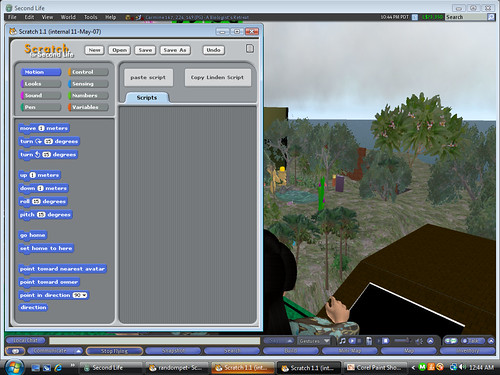
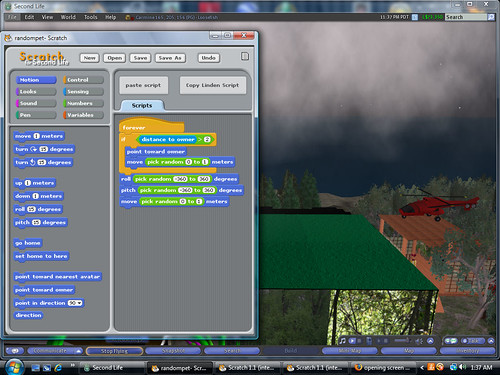
S4SL is developed by Eric Rosenbaum at MIT, using Scratch . Scratch allows you to program graphically by snapping together little "modules." It sounds like a lot of fun in itself! But getting back to S4SL, the program has 8 classes of modules including one called pen which apparently requires an extra set of tools. Here is the opening window loaded along side the Second Life client. The left hand part of the window shows the eight modules, and the shapes associated with motion commands.

opening screen

Click on the image to go to my Flickr stream to see a large version of this screen. The basic idea is to snap together modules in S4SL. Then you press the copy code button. This copies the generated SL script into your clip board. So all you need to do is to rez an object SL, and paste the code in place of a new script.

S4SL is loads of fun and I spent a delightful evening making little Second Life "pets" that follow my Avatar around. The next image shows a Scratch program for a pet that exhibits random motion, but then attempts to find my avatar if it gets too far away.

Image3

The "modules" are color coded based on function and notice how the "modules" can be snapped together. This sort of approach ought to be appealing for novice programmers including biology types who are of course used to thinking of shape as related to function.

There are some limitations to S4SL. First, since it is in development, only some of the capabilities of SL's language are implemented. The code is fat, meaning there is a lot of non functional material in the code depending what sorts of features are enabled or disabled. Also the resulting code, because not everything is implemented may not work the way the user expects.

Originally I pasted the script into a cube prim for testing but it so happened I had a flexi prim representation of a phospholipid hanging around and I thought it would make a cool bacterium complete with flagella. So here is a brief movie (A still is here) of the resulting "bacterial cell:"


I think S4SL has a lot of potential as a learning tool. For instance someone interested in behavior could use the system, as my example suggests, let students design bots which mimic different sorts of orientation behavior. Students without any programming experience can give their simple prims behaviors and there are good pre-made S4SL projects that come with the down load to show how this can be done.

S4SL, a neat learning tool and lots of fun and it doesn't require any scratch for the fun.

Wednesday, June 25, 2008

Busted!

Global warming skeptics that is. Turns out they are taking a page from Creationists who love to put out lists of scientists who support their positions. Over at Lightbucket there is an interesting post shedding light on the antics of the Heartland Institute(website, sourcewatch) with it's list of 500 scientists who are supposedly global warming skeptics.

Check it out at:
http://lightbucket.wordpress.com/2008/05/06/the-heartland-institutes-500-scientist-list/

From the post:

"The list of Dennis Avery’s coauthors immediately looks odd. Some of the scientists are dead, some don’t exist [6], and the deceased astrologer Theodor Landscheidt is on it. Extraordinarily, Michael Mann, the author of the “hockey stick” paper, and one of the scientists running the RealClimate blog, is on the list as a coauthor “whose research contradicts man-made global warming” !"

Desmogblog at http://www.desmogblog.com/ has been doing a great job of tracking this story.

See that blog's latest update at http://www.desmogblog.com/500-scientists-with-documented-doubts-about-the-heartland-institute

Friday, May 30, 2008

The Evolution of Beauty

I am never away from thinking about evolution. Being at Disney last week taking lots of pictures of flowers, got my thinking about evolution and beauty. Take this shot of a flower from Disney:

Spathe

Actually this structure is called a spathe and it really a group of fused flowers wrapt around by a leaf. Think of Jack in the Pulpit and you have idea.


At first glance, not a traditionally beautiful picture and yet if you really look at it I suspect you will see a certain sensuousness to this image. I am reminded of Georgia O'Keeffe who allegedly said she painted flowers because she couldn't afford models. The traditional explanation for why flowers are beautiful is that that this is a by product of the coevolution between flowers and pollinators. But that really doesn't explain why they are beautiful for us. Part of the answer maybe that flowers also coevolved with us and breeders selected for beauty. But why beauty in the first place?

In terms of sexual beauty and attractiveness, it appears that humans and other animals have innate neurological biases that operate in conjunction with Darwinian sexual selection leading to elaboration of certain characteristics. But why these biases? Why not just respond to the narrow signs required for our reproduction and not feel rewarded emotionally by flowers and other things that we see as beautiful be it a flower, a poem or a butterfly?

Rhododendron


Of course, I would want an evolutionary explanation because of my (innate perhaps?) desire for explanation. How do things come about? How do they work? But just because scientists are interested in these sorts of questions no way diminishes the emotional response and appreciation of beauty in all its forms.

Nor does beauty exist in a vacuum. Our innate neurological biases may be enhanced or over ridden by our experience or cultural preconceptions. For instance for me the beauty of the Rhododendron in the picture above is enhanced by the presence of these little bug (actually Katydid) nymphs:

Rhododendron and bug

There is a richness of connection that the nymphs add that for me is itself part of beauty and would be missing if I had taken a shot of the flower alone.

Monday, May 12, 2008

Update on Expelled! Was Behe expelled?

I am no fan of Michael Behe but according to this post at Darwinian Conservatism he was expelled from Expelled. Seems he is just too independent for some of the other ID'ers.

Thanks Larry for pointing this gem out.