This is a great time to be involved in genetics because there is so much change happening in all areas of genetics from real basic stuff such as the nature of the gene to how genes figure into evolution.
There is a great series of articles in the New York Times science section that you ought to look at to get some sense of the excitement today in genetics.
The first article by Carl Zimmer looks at the genome, all the DNA found in our chromosomes. The article focuses not so much on the classical protein coding genes that every one thinks about the rather the 99% of the DNA in our cells, that is not well understood. The article also delves in to what do we mean by a gene any way? The concept started with Mendel who not knowing about DNA called genes factors. During most of the 20th century we taught that genes code for proteins but now we understand that genes are a lot weirder than the cut and dry protein coding segments of DNA we thought they were.
The next article by Andrew Pollack looks at RNA and the many roles of this molecule in genetics. We used to think that there were three types of RNA, ribosomal, transcript and messenger but now we understand that there are other types of RNA that are involved in the regulation of genes and their expression. Some of these RNA’s may revolutionize the way we treat certain diseases.
The next article in the series by Benedict Carey looks at new hypothesis about mental illness which says that certain types of mental illness might result in the conflict of genes from a person’s parents.
The notion that genes may be in conflict with one another may seem odd, but here is an example. We know that there are genetic elements that make extra copies of themselves in the genome or bias the results of meiosis so that more of them get passed on to the offspring even at the expense of the fitness of the individual organism. It turns out that in response to these sorts of “selfish elements”, other genes suppress the activity of the “selfish genes” . Gene conflict also plays out in the male parent’s vs the female parent’s genes during development and the article discusses an interesting example of that.
The notion of gene conflict in an evolutionary sense is well established for certain type of genes but if this idea is true it would mean that certain types of mental illness are not so much due to what genes you have but which genes “win” the gene conflict and are expressed.
These articles may seem quite different but they all have a couple of common threads. First of all they illustrate the dynamic nature of science and how scientists rather than wanting to defend simplistic views of science are constantly challenging established science as new empirical evidence becomes available. Second these articles each in their own way get at the limitations of basic concepts and levels of analysis used in science. In the first article, the gene concept, which started out with a gene as an indivisible factor like a bead on a string, has morphed into a series of somewhat different concepts to the point where you can’t always tell where one gene begins and another end.
The second article lays waste to the idea that everything in the cell is controlled somehow by the DNA working with proteins. RNA’s also are involved in determining which genes are expressed and which are not. So here our original understanding of RNA again has been altered due to some very interesting discoveries, some of which were quite accidental.
The 3rd article takes the role of genes in mental illness and for that matter lots of other situations a step beyond what genes are present as being important, but to a view point that within an individual genes may be in “conflict”, so our notions of genotype (typically defined as the specific combination of genes an individual has) turn out to be way too simplified. Not only that the notion of gene conflict introduces a whole shadow world with in an individual organism so that the individual become like a house divided…divided by an evolutionary conflict between the organism’s own genes.
So check these articles out and let me know what you think.
Showing posts with label genetics. Show all posts
Showing posts with label genetics. Show all posts
Tuesday, November 11, 2008


Tuesday, November 04, 2008
Mendel's Garden Is Up Again!
Check out the latest edition at Evolgen!
http://scienceblogs.com/evolgen/2008/11/mendels_garden_25.php
http://scienceblogs.com/evolgen/2008/11/mendels_garden_25.php
Sunday, June 15, 2008
Protein Motif
Protein Motif
Originally uploaded by pdecell
The video was produced using Camtasia Studio, as a windows media file, and uploaded to Flickr. Flickr can only make 90 second videos and apparently takes the format you upload and processes it into an Adobe Flash file. What is frustrating aside from the 90 second limit is that Flickr won't accept Flash files!
The sound track is a translation of a protein called Gamma Crystallin, courtesy of Max Chatnoir of Genome Island.
If you have Second Life installed:
Visit Simone and her sculpture at:
slurl.com/secondlife/Carmine/167/208/155
and visit Max at Genome Island at:
slurl.com/secondlife/Genome/128/128/0
As a tip, use the highest quality settings you can use to produce your video before uploading to Flickr. I could not get mov files to work but Windows media files worked fine. Flickr does have a video upload limit of 150MB.
Friday, March 14, 2008
A Second Life Field Trip
 My genetics syllabus had for the first time a field trip scheduled as part of the lab. Not to a see some exotic genetic oddity or a biotech company. Instead, I decided to take my students on a little excursion in Second Life to Max Chatnoir's Genome Island. I blogged about Max last year and she has made many changes to her site making it much more open and easy to navigate. So, with the help of JCCC's Education Technology Center which provided a computer lab with Second Life ready to go, today Friday the 14th was the day for the trip.
I have been in Second Life for almost three years been in world with groups of faculty. But I had never led a group myself. During Wednesday's lecture, I gave them a little show and tell about Second Life and developed a brief tutorial for them to read about how to register and create an avatar. They had to do the registration process to get a basic account on their own as an out of class assignment. Most students managed to do that without any difficulty.
 In the computer lab today I had them log on to the Second Life client. This puts them in Second Life's orientation area. I had them move to a quiet spot where I had them add my avatar, Simone as a friend and also join a group so that I could talk to them and send them teleport notices if they got lost.
 In the computer lab today I had them log on to the Second Life client. This puts them in Second Life's orientation area. I had them move to a quiet spot where I had them add my avatar, Simone as a friend and also join a group so that I could talk to them and send them teleport notices if they got lost.
 The group's notice had a note card with landmarks to the sites were visiting today. I asked them to keep this note card in their inventory but leave it open as a small window.
By the way, Second Life's orientation site is much less confusing than when I had to go through the process, but with a group it seemed best to do my own orientation.
 So I had them immediately teleport to my land via a landmark on the note card and showed them the basics of moving and interacting with objects for maybe 5 minutes. Here is my main avatar Simone waiting for them to arrive. I had a scripted sign ready to show them how to interact with objects-in this simply to get another copy of the note card.
Here is some of my class arriving at my land for their brief orientation.
 Then we were off to Genome Island where Max Chatnoir was graciously waiting for us. Max, in the white coat, first took us to Mendel's Abbey and garden where she has a very nice simulation of Mendel's crosses. One nice feature, is a link to an Excel spreadsheet where students can record the phenotype of the plants produced by successive breedings. We also saw a work in progress-a translation game where students could play the part of tRNA's selecting the proper amino acids. A very cute breeding experiment involving sex linkage of coat color in cats is also worth a look.
 Next we went to Genome Tower. This used to be an enclosed skyscraper like affair, but Max has nicely opened it up by having platforms connected by ramps, the platforms being ringed by barriers to keep the visitor from falling over the edge. Some of my old favorites are still around such as the fruit fly lab and the human chromosome exhibit shown here. She has refined and added new things such as a comparison between the chromosomes of different mammals showing regions of chromosomal synteny which is a type of homology allowing scientists to infer the sorts of chromosomal changes that may have happened in the evolution of a particular group of species.
 In real life Max has done some interesting things translating protein and DNA sequences to sounds. She says that hearing the amino acid sequences reveals organizational patterns not apparent visually. Here are some of my students with Max at her protein music station. An exhibit has mp3 files of the results. But given time constraints and lag we didn't get to listen to the files. We are just doing protein structure as part of translation..so this will require a return trip.
Links about her work with John Dunn on protein and DNA music:
This link plays samples of the music...wonderful.
 We also visited Scilands orientation site. This is a nice alternative to Second Life's normal orientation and had I known how nice it is, might have opted to run my students through it rather than orient them at my Second Life home. There are also teleport sites to other science sites, commercial, academic and government.
All in all a very interesting trip. There were a few minor glitches. One was that our lab's computers did not have the latest Second Life client with the built in media browser and there was no web on a prim. Lag was a problem and the immediate student complaint because of it was that Second Life was slow. Indeed chat was slow which made things confusing. We did have maybe 20 people in the same sim (simulation) at various times and all the chatting combined with various objects whispering to us combined with the lag made it a bit difficult to play with Max's experiments. There were also a couple of amusing teleport problems.
After about 2.5 hours it was time to take leave of Max, who was most patient with me and my group of Second Life novices. From my perspective as a teacher the trip was a good introduction to Second Life and the students seemed to grasp the idea of how Second Life worked. After leaving Max we returned to my home where I showed them a few other things, such as building and a bit about scripting. I left them with a WEBCT/Blackboard assignment namely to provide some feedback on their Second Life experience-what they liked and didn't like and why. It will be interesting to see their written reactions.
So if you are going to take a group of Second Life Novices here are some tips.
 1. Do some advance planning and determine whether you are going to have them go through Second Life's orientation or take the group to another site for a less confusing orientation. Since it had been three years since my Second Life birth, I created a new basic membership avatar to run through the registration process just to see how it had changed. I made a quick and dirty tutorial for them including pictures of the registration process and what students would see in Second Life. One nice improvement is the avatar selection screen which gives the new Second Life citizen a wide range of avatars to start from. My student really seemed to like that.
 1. Do some advance planning and determine whether you are going to have them go through Second Life's orientation or take the group to another site for a less confusing orientation. Since it had been three years since my Second Life birth, I created a new basic membership avatar to run through the registration process just to see how it had changed. I made a quick and dirty tutorial for them including pictures of the registration process and what students would see in Second Life. One nice improvement is the avatar selection screen which gives the new Second Life citizen a wide range of avatars to start from. My student really seemed to like that.
 2. Create and have the students join a Second Life group to facilitate keeping every one more or less together or at least in the same universe worked very well. I think my group size - 15 students- is probably the maximum size to handle at least if you are going to intensively interactive sites such as Genome Island.
3. If you are visiting a site- try to let the site owner know you are coming. At least in the Science sites the owners or creators love to show off their stuff. They also like to see how visitors react to things on their site. Again scope out the site before you go and have some idea what you want them to see.
 4. Warn them of potential problems. For instance since when you log on for the very first time you get dumped into Second Life's orientation, I warned them to get out of the way of new avatars coming in behind them. Also I warned them a about the possibility of "griefers" and that they could encounter mature areas with explicit sexual materials.
 Being with them in a lab where they could see my view projected on a screen made dealing with any problems easier. Plus they go to see several amusing teleporter incidents.
One thing I might have done in retrospect is give them some Second Life money (Lindens) to spend since they just got free basic memberships.There were several vending machines in the science areas selling shirts and other goodies for nominal fees say 10$L and that might have been fun. Fortunately Max had outs of free shirts for the group.
Thanks to Max for graciously taking the time to show us around and JCCC's Ed Tech Center for providing lab space for our trip.
Monday, December 10, 2007
Mendel's Garden #21 is now up!
Check out the best in genetics blogging at Inoculated Mind. Hard to believe this is the 21st edition of Mendel's Garden.
http://www.inoculatedmind.com/2007/12/10/mendels-garden-21/
http://www.inoculatedmind.com/2007/12/10/mendels-garden-21/
A Big Day in Boston!
If you are a Boston single, as of today you have a new option to find a mate. A company called scientificmatch.com has a new wrinkle in the match making game-matchmaking based on DNA analysis. The idea is to find a mate based on the compatibility of the genes related to characteristics of the immune system. The company's website claims:
I must remain very skeptical for now. By the way, a one year membership costs $1,995.95. So if this system is an improvement over the old fashioned way of finding a mate-is that improvement great enough to make the cost worth it? This is especially true since the company makes the case that odor is an important part of compatibility. Maybe the company's owner ought to consider making little scratch and sniff tabs with arm pit odor that clients can give to each other. But perhaps that is not as sexy as DNA analysis.
The web site suggests that the company is planning on expanding to other cities, so have a look and let me know what you think.
"When you share chemistry with someone:
- 1. You love their natural body odor. They smell “sexier” than other people.
- 2. You have a more satisfying sex life.
- 3. If you’re a woman, you have more orgasms.
- 4. There’s significantly less cheating in your relationships than if your DNA isn’t matched properly.
- 5. As a couple, you're more fertile.
- 6. Your children have a better chance of being healthy."
I must remain very skeptical for now. By the way, a one year membership costs $1,995.95. So if this system is an improvement over the old fashioned way of finding a mate-is that improvement great enough to make the cost worth it? This is especially true since the company makes the case that odor is an important part of compatibility. Maybe the company's owner ought to consider making little scratch and sniff tabs with arm pit odor that clients can give to each other. But perhaps that is not as sexy as DNA analysis.
The web site suggests that the company is planning on expanding to other cities, so have a look and let me know what you think.
Saturday, December 08, 2007
Synthetic Biology
One of the hottest areas of biology today is synthetic biology. Synthetic biologists are not content to take a gene from one species and insert it into the genetic material of another species.
Instead, synthetic biologists are attempting to build a set of standard building blocks often by synthesizing DNA from scratch. The idea is to have a set of modules that can be plugged together to make the biological equivalent of electrical devices.
So just as an electrical engineer designs new circuits by plugging together standard parts on a breadboard, the synthetic biologist attempts to create custom organisms by inserting these biological circuits into cells.
The field has progressed to the point where there is an annual student competition at MIT dedicated to designing custom devices called iGEM which stands for International
Genetically Engineered Machine Competition. The winners of the 2007 competition have just been announced and they include teams that developed applications of synthetic biology to medicine, environmental sensing, energy and information processing.
For example a team from Alberta Canada developed a synthetic set of genes involved in the production of butanol, an organic compound that could serve as a fuel alternative to ethanol.A team from University of Missouri at Rolla, the Missouri Miners developed a biological breathalyser and a biological timer.
Synthetic biology is in its infancy and the power of this technology is rapidly increasing, much like the power of computers, so that soon synthetic biologists may be able to construct synthetic organisms entirely from scratch!
Links
Syntheticbiology.org
Synthetic Life, Scientific American 2004
Instead, synthetic biologists are attempting to build a set of standard building blocks often by synthesizing DNA from scratch. The idea is to have a set of modules that can be plugged together to make the biological equivalent of electrical devices.
So just as an electrical engineer designs new circuits by plugging together standard parts on a breadboard, the synthetic biologist attempts to create custom organisms by inserting these biological circuits into cells.
The field has progressed to the point where there is an annual student competition at MIT dedicated to designing custom devices called iGEM which stands for International
Genetically Engineered Machine Competition. The winners of the 2007 competition have just been announced and they include teams that developed applications of synthetic biology to medicine, environmental sensing, energy and information processing.
For example a team from Alberta Canada developed a synthetic set of genes involved in the production of butanol, an organic compound that could serve as a fuel alternative to ethanol.A team from University of Missouri at Rolla, the Missouri Miners developed a biological breathalyser and a biological timer.
Synthetic biology is in its infancy and the power of this technology is rapidly increasing, much like the power of computers, so that soon synthetic biologists may be able to construct synthetic organisms entirely from scratch!
Links
Syntheticbiology.org
Synthetic Life, Scientific American 2004
iGem2007
Missouri Miners
Cross posted to Dangerous Ideas
Sunday, October 07, 2007
Molecular Beauty
My genetics students have a little assignment. I have been slowly introducing them to some of the major bioinformatics tools available through the National Center for Biotechnology Information.
The idea is to get their feet wet so that they can go further on their own and not be too intimidated by reams of forbidding looking database records.
So far they have looked at OMIM and BLAST. This weekend their task is to load NCBI's Cn3D protein and nucleotide molecular viewer. The next step is for them to find certain important molecules related to genetics so we can make a molecular gallery for the class.
The Cn3Dprogram allows researchers to see and manipulate nucleic acid and protein structures in various ways. Since we have just finished the basics of DNA replication, and are getting ready to do protein synthesis and the regulation of gene expression, I hope that looking at some of the major actors in these processes will help the students become more comfortable with these molecules, more so than looking at a flat amino acid or nucleotide sequence.
Beauty is at all levels of organization; the balance of order and spontaneity that I think makes for beauty, is evident even at the molecular level. So I thought show a few examples beyond the iconic DNA double helix.
My first example, shown in the picture above is a protein that serves as a transcription factor. The proteins polypeptide chains appear pale blue. and it is bound to a DNA molecule shown in the dark blue and brown helical strands on the right. The structure is from a paper by Beth A. Chaney, Kimber Clark-Baldwin, Vrushank Dave, Jun Ma, and Mark Rance
Biochemistry, 2005, 44, (20), pp 7497–7511.
If you want to see and manipulate this and other structures I mention, download the Cn3D viewer, follow the instructions and then go to this structure summary link.
This particular transcription factor binds to a small region of DNA called a homeobox. Homeoboxes are important in the patterning of development. The transcription factor called Pituitary homeobox protein is critical for proper development of the anterior portion of the eye. Mutations in the gene coding for the transcription factor often lead to a syndrome called Rieger syndrome (OMIM = 601542).
 Here is a different rendering also rotated a bit, showing a space filling model of the homeobox protein bound to the DNA. The DNA double helix is shown in blue and brown, the homeobox protein is in pink.
One of the nice things you can do with the viewer is highlight different parts of the molecule that might be involved in a binding site with your mouse. The part you select is also highlighted in the sequence data window. This is very useful for activities ranging from drug design to studying protein evolution.
 So you can see how this works, here is a screen shot showing a particular amino acid in the protein and a guanine to which it binds in the DNA.
But I stray from my main theme, and that is beauty at the molecular level. Maybe a transcription factor has a beauty only a molecular geneticist can love, but what follows are several beautiful molecular structures, rendered using the viewer along with their structure summary links for those who want to examine them in different ways using the viewer.
 A Nucleosome.
Nucleosomes are the basic structural unit of chromosomes in eukaryotic cells, such as the cells in your body. Nucleosomes consist of a core of proteins called histones around which wrap a two coils of DNA. Can you pick out the DNA?
Structure summary.
A DNA mimic.
Gyrases are enzymes that manipulate the coiling of DNA during DNA replication. These are the sorts of enzymes one might which to have when trying to detangle fishing lines or kite strings. Unfortunately Gyrases only work on DNA. In searching for gyrases, I found this wonderful protein which turned out not to be a gyrase but rather a protein called a The Pentapeptide Repeat Protein. It is from the bacterium which causes tuberculosis. These sorts of proteins are wide spread in bacteria and their usual function is not known. But in the tuberculosis organism this protein confers resistance to a class of antibiotics called Fluoroquinolones. I also inhibits the activity of gyrases. It can do this because the pentapeptide repeats (brown) mimic the geometry and charge properties of DNA.
I show two angles so you can see better just how neat this molecule is!


Structure summary.
Sliding clamp protein.
Clamp proteins hold DNA in place, for example during DNA replication and clamp proteins seem to often have really interesting structures as in my example.


A different rendering of the same clamp shows that each of the rings is made from three polypeptides. So think of the clamp as a machine with six large molecules for parts!
So I hope you can see some of the beauty I see in these structures. Lest anyone try imbuing these structures with metaphysical freight, to me the real beauty is that even within the confines of the cell evolution has produced adaptations at the nano scale every bit as wonderful as the large scale adaptations of organisms to their environments.
The idea is to get their feet wet so that they can go further on their own and not be too intimidated by reams of forbidding looking database records.
So far they have looked at OMIM and BLAST. This weekend their task is to load NCBI's Cn3D protein and nucleotide molecular viewer. The next step is for them to find certain important molecules related to genetics so we can make a molecular gallery for the class.
The Cn3Dprogram allows researchers to see and manipulate nucleic acid and protein structures in various ways. Since we have just finished the basics of DNA replication, and are getting ready to do protein synthesis and the regulation of gene expression, I hope that looking at some of the major actors in these processes will help the students become more comfortable with these molecules, more so than looking at a flat amino acid or nucleotide sequence.
Beauty is at all levels of organization; the balance of order and spontaneity that I think makes for beauty, is evident even at the molecular level. So I thought show a few examples beyond the iconic DNA double helix.
My first example, shown in the picture above is a protein that serves as a transcription factor. The proteins polypeptide chains appear pale blue. and it is bound to a DNA molecule shown in the dark blue and brown helical strands on the right. The structure is from a paper by Beth A. Chaney, Kimber Clark-Baldwin, Vrushank Dave, Jun Ma, and Mark Rance
Biochemistry, 2005, 44, (20), pp 7497–7511.
If you want to see and manipulate this and other structures I mention, download the Cn3D viewer, follow the instructions and then go to this structure summary link.
This particular transcription factor binds to a small region of DNA called a homeobox. Homeoboxes are important in the patterning of development. The transcription factor called Pituitary homeobox protein is critical for proper development of the anterior portion of the eye. Mutations in the gene coding for the transcription factor often lead to a syndrome called Rieger syndrome (OMIM = 601542).
 Here is a different rendering also rotated a bit, showing a space filling model of the homeobox protein bound to the DNA. The DNA double helix is shown in blue and brown, the homeobox protein is in pink.
One of the nice things you can do with the viewer is highlight different parts of the molecule that might be involved in a binding site with your mouse. The part you select is also highlighted in the sequence data window. This is very useful for activities ranging from drug design to studying protein evolution.
 So you can see how this works, here is a screen shot showing a particular amino acid in the protein and a guanine to which it binds in the DNA.
But I stray from my main theme, and that is beauty at the molecular level. Maybe a transcription factor has a beauty only a molecular geneticist can love, but what follows are several beautiful molecular structures, rendered using the viewer along with their structure summary links for those who want to examine them in different ways using the viewer.
 A Nucleosome.
 Nucleosomes are the basic structural unit of chromosomes in eukaryotic cells, such as the cells in your body. Nucleosomes consist of a core of proteins called histones around which wrap a two coils of DNA. Can you pick out the DNA?
Structure summary.
A DNA mimic.
Gyrases are enzymes that manipulate the coiling of DNA during DNA replication. These are the sorts of enzymes one might which to have when trying to detangle fishing lines or kite strings. Unfortunately Gyrases only work on DNA. In searching for gyrases, I found this wonderful protein which turned out not to be a gyrase but rather a protein called a The Pentapeptide Repeat Protein. It is from the bacterium which causes tuberculosis. These sorts of proteins are wide spread in bacteria and their usual function is not known. But in the tuberculosis organism this protein confers resistance to a class of antibiotics called Fluoroquinolones. I also inhibits the activity of gyrases. It can do this because the pentapeptide repeats (brown) mimic the geometry and charge properties of DNA.
I show two angles so you can see better just how neat this molecule is!


Structure summary.
Sliding clamp protein.
Clamp proteins hold DNA in place, for example during DNA replication and clamp proteins seem to often have really interesting structures as in my example.


A different rendering of the same clamp shows that each of the rings is made from three polypeptides. So think of the clamp as a machine with six large molecules for parts!
So I hope you can see some of the beauty I see in these structures. Lest anyone try imbuing these structures with metaphysical freight, to me the real beauty is that even within the confines of the cell evolution has produced adaptations at the nano scale every bit as wonderful as the large scale adaptations of organisms to their environments.
Sunday, September 09, 2007
Mendel's Garden at Balancing Life....
Another great edition of Mendel's Garden is up at Balancing Life...
http://balancinglife.blogspot.com/2007/09/mendels-garden-at-balancing-life.html
http://balancinglife.blogspot.com/2007/09/mendels-garden-at-balancing-life.html
Thursday, August 09, 2007
Persistence
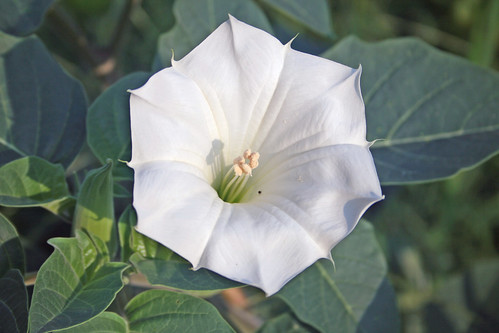
High summer is here and the warm
Annual grasses spider across the earth.
Sedums in the garden wilt.
You have to be a master gardener here
My neighbor said today at market.
We talked of worms
Wrapping her red bud in brown webs
Just a week after spraying.
The eggs were there I said
Or laid just after the chemical
Had broken down.
Kansas webworms waving
Under their palace of threads.
I pull the annual grasses from my beds
But save the Datura which wander
From year to year.
These are my plants, leaves blue
In the thick stemmed August days.
The flowers are white dresses
Worn freely in the night,
Only a surprise flash of cotton
In the rising sun.
But more buds swell greedily
Await their turns to be worn
In the August night,
More buds swollen in the invisible hand
Of persistence.
Commentary. This is the third poem that I have written over my life a poet about Datura. I am not sure why the fascination with this plant. I guess because it is so surprising. Seeing the plant in the day, flowers shriveled one might not guess just how wonderful its night blooming flowers are. I still remember the first time I saw this plant in New Mexico. We had been traveling a poorly marked dirt road and ended up winding down a steep canyon. As I came around a bend in the shadows there was this plant full of these wonderful pure white flowers. I guessed Datura, and realized that we had been driving by lots of these plants. Only the flowers were shriveled in the sun.
Sometimes we make a big deal of persistence. It is one of those American half truths. If you are persistent you can do anything or realize your dreams. Well the truth is many times you can't. That doesn't mean you shouldn't be persistent. I am not a fatalist after all. Instead the point of the poem in part is that persistence really is no big deal-it is part of our Darwinian legacy. After all, do you have any genes that were contributed by organisms who were not your direct ancestors? Granted, new forms of genes and new genes arise like buds and are passed on if persistent enough in a metaphorical sense. But these arise from mutations in genetic material passed from generation to generation. There are even so called immortal genes involved in critical biological processes which are basically unchanged, persisting today in all organisms from deep sea vent Archea, to starfish, Datura and humans. Persistence then is not always heroic, but happens quietly at a very basic level.
Indeed DNA as noted by Brenda Maddox in her biography of Rosalind Franklin "reverses the tendency of matter to become disordered and allows new molecules to be the same as the old." True, this is the persistence from which all other forms of persistence are derived from. And yet note, just as the Datura opportunistically self sow (wander from year to year), the persistence embodied in the fidelity of the DNA copying process also makes possible the natural selection of mutations best suited for particular environments. So persistence and change, opportunism if you will, are each required for the other to happen.
Sunday, June 24, 2007
At the Milkweed...
 On Friday I had a yellow tiger swallowtail (Papilio glaucus ) pass through the garden. These butterflies are quite active fliers and I have not had much luck getting good shots in the past. This one is almost too good; the butterfly looks flat to me. (click on the image for a larger view) It is on my swamp milkweed.
These butterflies are quite interesting. There are two adult color phases in the females, the light phase shown here and a dark phase-the black tiger swallowtail -which is apparently involved in a mimicry system with the pipevine swallowtail. See this site for more pictures of larvae and adults.
The genetics of this color system is quite interesting. First, realize that unlike mammals, the females are "XY" , usually denoted "ZW", and the males are ZZ. So the females in butterflies are called heterogametic, since they produce gametes which can have either of the thew two different sex chromosomes. In contrast in mammals the males are the heterogametic sex, with the females being homogametic.
According to Scriber et al (1996), the genetic system related to which form the butterfly becomes (yellow or black tiger swallowtails) involves two loci. The first locus is a W linked locus, that has an allele b that when present leads to the production of the black, or melanistic, black swallowtail. Here I am following the notation given here.
Since the females are ZW, black tiger swallowtail females only produce black tiger female offspring while the yellow swallow tail females only produce yellow female offspring. The males always have yellow wings.
The second locus, which is Z linked that has an allele scan which can "suppress" the expression of the W linked allele b . So presumably a female that has the b allele on her W chromosome would be the black tiger form if she has scan at the second locus.
 So to give an idea about how this works, suppose a female black swallowtail butterfly has genotype b s (where s by itself represents the non suppressor allele mates with a male who is heterozygous scan/s. All the male offspring will, of course be yellow, since the males do not have the W chromosome with its b allele. Half the female offspring will have genotype b s and hence be black. The other half will have genotype b scan and will be yellow.
On occasion, a butterfly is found with a one black swallowtail wing and one yellow swallowtail wing. For instance, to the left is a picture taken by Jay Joslin on a cell phone camera. These appear to be gynandromorphs, animals which are mosaics with a mixture of male and female characteristics. The term is not used for humans. In insects, gynandromorphs typically are genetic mosaics, some cells being "XX", other cells being "XY". Here is a good discussion of gynandromorphs showing different types of gynandromorphs in tiger swallowtails.
Funny that this concept arises now, since I am currently reading Middlesex by Jeffrey Eugenides. The protagonist in this book is a chromosomal male who is pseudohermaphrodite, with ambiguous genitalia. But this is due to a recessive allele on chromosome 5 of a gene for a an enzyme called 5-Alpha Reductase. This enzyme catalyzes the conversion of testosterone to another sterol called DHT. This is the molecule associated with certain types of baldness but more importantly DHT is required for normal development of the external male genitalia. Here is a good discussion of the genetics of 5-Alpha Reductase deficiency. So Cal, Eugenides' protagonist is not a genetic mosaic as are the gynandromorphs in the insect world. There is more to the genetics of Middlesex...but that will have to wait.
But situations analogous to insect gynandromorphs, in that individuals are genetic mosaics with respect to the sex chromosomes, do happen in people. For instance, persons with Klinefelter's syndrome, are sometimes mosaics. This happens when the sex chromosomes fail to segregate early in development leading to some lines of cells in the embryo that are XXY and others which are XY. See this reference. We do not find the sort of symmetric situations found in butterflies-male external characteristics on one side and female on the other- in mammals because mammalian development is indeterminate as opposed to determinate meaning that the fate of cells in insects is set very early on. So which cells end up on the left vs right side of the insect is set at the first division of the zygote.
Also sex germination in butterflies is not exactly the same as in people since what is critical is the number of Z chromosomes relative to the number of W chromosomes. So Butterflies that are ZW are female but butterflies with a W chromosome but more than one Z chromosome may be male depending on the species. So if a non disjunction event happens in the first division leading to the 2 cell embryo in a black swallowtail female , one side of the insect will end up having ZW cells and be the black swallowtail phenotype. The other side will presumably end up ZZW, which in butterflies is (at least often) male. This side will have the yellow tiger swallowtail coloration.
Other links:
J. Mark Scriber, Robert H. Hagen, Robert C. Lederhouse Evolution, Vol. 50, No. 1 (Feb., 1996), pp. 222-236
Reed, Robert D. and Sperling, Felix A. H. 2002. Papilionidae. The Swallowtail Butterflies. Version 21 February 2002 (complete). http://tolweb.org/Papilionidae/12177/2002.02.21 in The Tree of Life Web Project, http://tolweb.org/
Wednesday, May 30, 2007
Sex in humans: It's a delicate balance.
For years we have been taught that during human development the default sex was female and an individual with a copy of the SRY gene would develop into a male. There is an interesting interview with Eric Vilain from the University of California in this month's Scientific American. Dr. Vilain's work has updated this simplistic notion and his work has implications that go beyond genetics.
Dr. Vilain studies intersex individuals. He got interested in this topic as a medical student in Paris. He was assigned to the pediatrics unit and was shocked at how doctors made decisions about gender assignment for children with ambiguous genitalia.
His lab has discovered that sex and perhaps gender seem to involve a balancing act between different sets of genes. On the one hand is the SRY gene. Balancing that appear to be a series of what he calls "anti male genes", for instance the WNT4 gene that he calls female specific. Indeed this gene appears to inhibit male hormone production by females. WNT4 and other sorts of genes may also prove to be not just "anti-male" but be required for proper ovarian development, but this still needs to be demonstrated.
Vilain's work has implications for the politics and handling of gender related issues. From the transgender perspective this work is interesting because it provides an approach that might help explain gender identity 'disorders' at least in some situations. After all the SRY gene appears to be expressed in the brain. Might the same hold true for some of these other genes related to gonadal development? Might gender identity and behavior be as much about genetics as about social construction?
Indeed in another interview Dr. Vilain has this to say about gender identity:
For the intersex community, his work has led to proposals to replace much of the nomenclature related to intersex individuals. In Vilain's view, the term 'intersex' is too vague and he would replace it with the term 'disorders of sexual development (DSD)'. Some in the intersex community support these sorts of changes because it would enable them to get medical treatment. Others think that the new nomeclature pathologizes what they view as 'normal variants.' Vilain responds:
Yet the intersex community is not abandoning the term intersex, but using it in the sense of an idenity rahter than a set of medical conditions. Sherri Morris makes this point quite clear in the ISNA blog:
So we see how genetics research affects more than just medical knowledge; it affects how we view ourselves at some very fundamental levels. For the subtle conflict and balance among the genes in the human organism is reflected in the complex nuances involved in even the most basic aspects of our identity, laying waste to the simplistic notions of male and female clung to by so many in our society.
Other Links:
Brian K. Jordan, Jennifer H.-C. Shen,Robert Olaso, Holly A. Ingraham, and Eric Vilain Proc Natl Acad Sci U S A. 2003 September 16; 100(19): 10866–10871.
Intersex Society of North America
Technorati Tags:
genetics
gender identity
intersex
Dr. Vilain studies intersex individuals. He got interested in this topic as a medical student in Paris. He was assigned to the pediatrics unit and was shocked at how doctors made decisions about gender assignment for children with ambiguous genitalia.
His lab has discovered that sex and perhaps gender seem to involve a balancing act between different sets of genes. On the one hand is the SRY gene. Balancing that appear to be a series of what he calls "anti male genes", for instance the WNT4 gene that he calls female specific. Indeed this gene appears to inhibit male hormone production by females. WNT4 and other sorts of genes may also prove to be not just "anti-male" but be required for proper ovarian development, but this still needs to be demonstrated.
Vilain's work has implications for the politics and handling of gender related issues. From the transgender perspective this work is interesting because it provides an approach that might help explain gender identity 'disorders' at least in some situations. After all the SRY gene appears to be expressed in the brain. Might the same hold true for some of these other genes related to gonadal development? Might gender identity and behavior be as much about genetics as about social construction?
Indeed in another interview Dr. Vilain has this to say about gender identity:
"This is really the big enigma and to me it's also the most important aspect of
sex determination to understand because I believe out of all the definitions of
sex, gender is the most important. In fact it's how people feel that is
important, regardless of what they look like, of what their levels of hormones
are, or what their face or genitalia look like. It's what they feel within
themselves."
For the intersex community, his work has led to proposals to replace much of the nomenclature related to intersex individuals. In Vilain's view, the term 'intersex' is too vague and he would replace it with the term 'disorders of sexual development (DSD)'. Some in the intersex community support these sorts of changes because it would enable them to get medical treatment. Others think that the new nomeclature pathologizes what they view as 'normal variants.' Vilain responds:
"We can play with words like that, but for practical purposes these "normal
variants" have a lot of health risks that require lots of visits to the doctor
for a bunch of issues that intersex patients have: fertility issues, cancer
issues (the testis inside the body can increase the risk of cancer), sexual
health issues. So if you're to start going to the doctor a lot for your
condition, you can call it a normal variant, but that's not really useful.
You're calling it a normal variant for political purposes."
Yet the intersex community is not abandoning the term intersex, but using it in the sense of an idenity rahter than a set of medical conditions. Sherri Morris makes this point quite clear in the ISNA blog:
"It would be a mistake to advocate that “intersex” be replaced with “DSD” within
such community, in the same way that people with a variety of different
conditions identify themselves using terms which may vary from the terms
employed by their health care providers. For example, instead of using a
diagnosis such as “achondroplasia,” many individuals with such conditions have
banded together using the term “Little People” because it reflects their
history, culture, and real-life experience."
So we see how genetics research affects more than just medical knowledge; it affects how we view ourselves at some very fundamental levels. For the subtle conflict and balance among the genes in the human organism is reflected in the complex nuances involved in even the most basic aspects of our identity, laying waste to the simplistic notions of male and female clung to by so many in our society.
Other Links:
Brian K. Jordan, Jennifer H.-C. Shen,Robert Olaso, Holly A. Ingraham, and Eric Vilain Proc Natl Acad Sci U S A. 2003 September 16; 100(19): 10866–10871.
Intersex Society of North America
Technorati Tags:
genetics
gender identity
intersex
Subscribe to:
Posts (Atom)