Friday, June 02, 2006

Follow up on Identity Police

As a follow up to my earlier post, Joe Nadeau, the choir director fired from St Agnes, has taken a job at First Lutheran Church in Mission Hills KS. Good to see he found an accepting church. What I find most telling is this quote from the Kansas City Star:

St. Agnes' pastor, Monsignor Gary Applegate, declined to comment on the situation.

The law doesn'’t allow me to comment on personnel matters, he said.

Uh huh.

I wonder how much of this is due to an emboldenment on the part of conservatives with the election of Pope Benedict. OK, the Church does not like homosexuality, but I think She blundered here badly, forgetting Her own teachings about the power of music. I know in my own faith life there have been times, and increasingly now is one of those times, when music is what connects me to God and the Church. I have, by the way, been in choir since I was eight or so. But last night I really questioned how I can do this, given the behavior of the Church on this issue.

Still other details are in this Kansas City Star article.

Technorati Tags:


Garden things


Getting ready to go out this afternoon for a ramble and decided I'd better see what's on my camera's memory card:

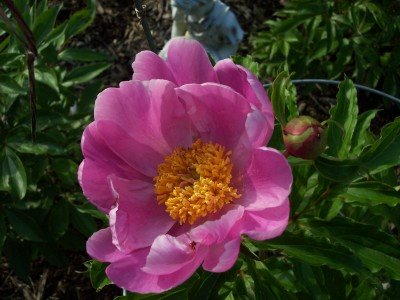
This peony is actually from last month. I have always been fascinated by the association between these flowers and ants. My peonies have been struggling and it is partly a drainage problem, but I think maybe it's the lack of ants in my yard.


Speaking of insects. Here is a tiger beetle. Usually they don't hold still along enough for me to shoot, but yesterday this one perched on a Viburnum twig for about a minute. I only wish I had a macro lens!


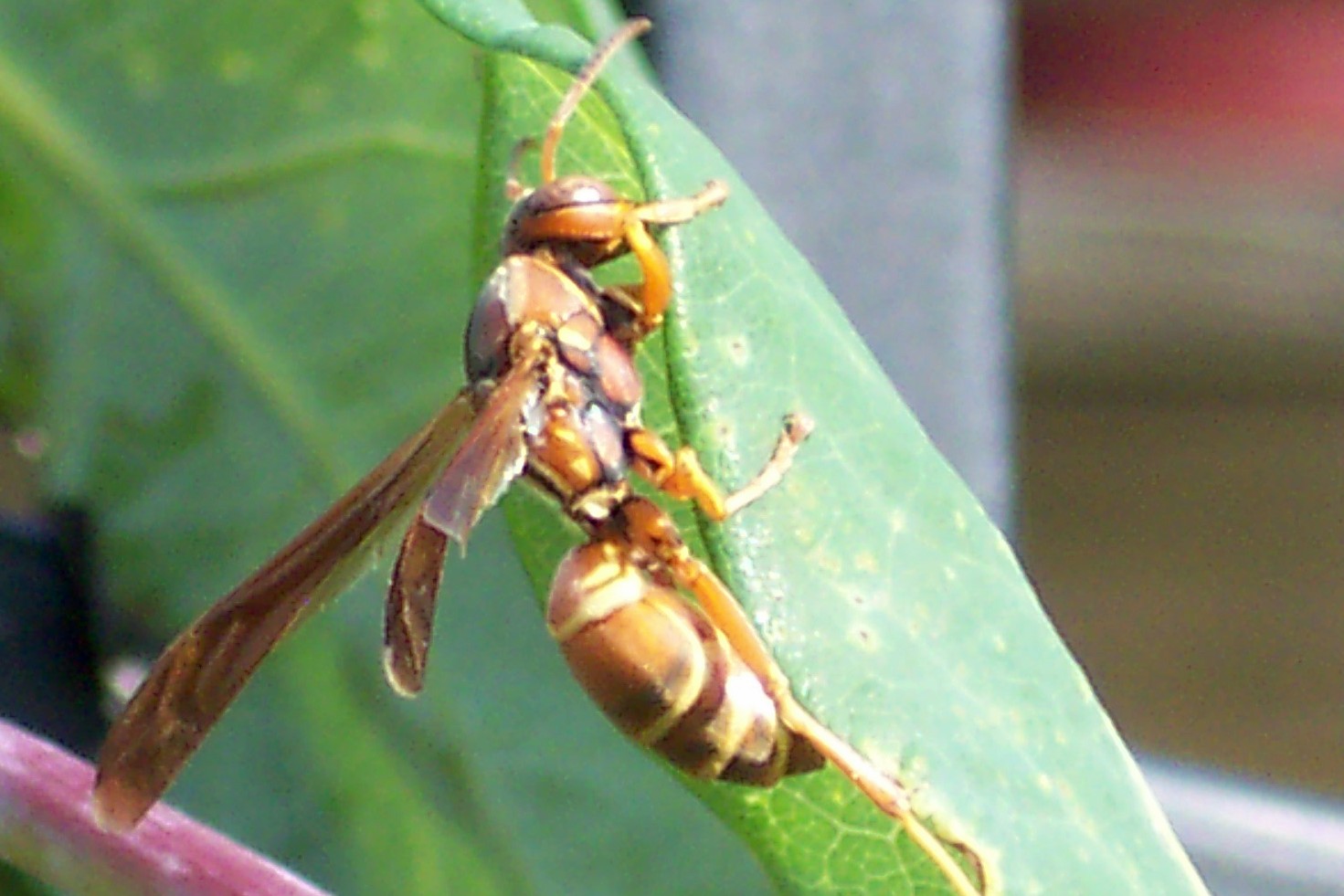
This paper wasp, Polistes exclamans, was foraging on my honeysuckle vine yesterday. Not sure what for, as it didn't seem to be finding any prey. A lot of wasps also collect nectar or aphid sap and it is probably an important source of energy for the adults.


Technorati Tags:

Kansas Guild of Bloggers

From emaw_kc comes news about the Kansas Guild of Bloggers:

Three O'Clock in the Morning: This thing's got legs

Check it out and if you are a Kansas Blogger, show your stuff.

Thursday, June 01, 2006

Unintended consequences of invasive species


An interesting article in this week's PLOS Biology reminds us that when we alter ecosystems, or for that matter any complex system, we cannot do just one thing. Stinson et al show through a set of very convincing experiments that an invasive species, the European Garlic Mustard, has an interesting effect on tree seedling in forests. Apparently this non native mustard reduces the growth of native tress seedlings by disrupting the mutualistic relationship between the roots of trees and the fungi that live with the roots. These sorts of mycorrhizal fungi are particularly important for woody plants but the garlic mustard and many other weedy invasive species apparently do not have these sorts of relationships.


Image from http://www.nps.gov/plants/alien/fact/alpe1.htm

The authors did a complex series of experiments to examine the affects of the mustard on woody seedling growth and colonization of roots by the mycorrhizal fungi. They concluded that the mustard does inhibit the colonization of woody seedling roots by the fungi, and that this inhibition is due to a chemical produced by the mustard that somehow inhibits the colonization of roots by the fungi.

What is unsettling is that the authors note that this effect is more pronounce in undisturbed habitats. They write:

"The strongest effects were observed for woody species most typically found in forested sites. These results indicate that the invasion of garlic mustard is more likely to negatively impact highly mycorrhizal-dependent tree seedlings than less-mycorrhizal-dependent plants. Thus, garlic mustard's successful colonization of understory habitat may be attributed in part to its ability to indirectly suppress woody competitors, and its effect on the native flora may be more detrimental in intact forests than disturbed sites. In addition, the data suggest that invasion by garlic mustard may have profound effects on the composition of mature forest communities (e.g., by repressing the regeneration of dominant canopy trees, and by favoring plants with low mycorrhizal dependency such as weedy herbs)."

The reason this is unsettling is that often in ecology we teach that mature, undisturbed habitats are less prone to invasion by weedy non native species and that these invasive species are problem mainly for disturbed habitats. Clearly this may not be the case!

References:

http://www.invasive.org/eastern/biocontrol/29GarlicMustard.html

Stinson KA, Campbell SA, Powell JR, Wolfe BE, Callaway RM, et al. (2006) Invasive Plant Suppresses the Growth of Native Tree Seedlings by Disrupting Belowground Mutualisms. PLoS Biol 4(5): e140

Technorati Tags:


Wednesday, May 31, 2006

Chronicles from Hurricane Country

If you want to see some wonderful bird and insect pictures check out Elissa Malcohn's post at her blog:

Chronicles from Hurricane Country: Habitat

I have only seen Owlflies a couple of times and I'm an entomologist.

Tuesday, May 30, 2006

Endless Forms Most Beautiful

If you want a good read, I strongly recommend Sean Carroll's Endless Forms Most Beautiful, briefly discussed earlier. This is a great synthesis of that branch of biology called evolutionary developmental biology(Evo Devo) which sits at the intersection of evolution and developmental biology and which is just beginning to go mainstream.

Triple Labeled Drosophila Larva. Used with permission:
http://www.molbio.wisc.edu/carroll/

Carroll makes the case that I try to pound into my students-namely that living things and the processes that go on in them are united by common descent and he does it with lots of cool examples that will quickly find themselves incorporated into my teaching and into my thinking about population genetics and evolution.

The last chapter is particularly relevant here in Kansas where the evolution vs Intelligent Design "controversy" is in full swing. To briefly summarize and comment:

Carroll reminds us of the scientific illiteracy of the United States compared to other countries: for example 52 percent of Americans do not know that the earliest humans did not live with dinosaurs. This is a problem for biology since as we know, evolution is the basis for biology as a science.

He then argues that we ought to stop teaching that evolution in terms of change in gene frequencies since that rapidly becomes abstract, and toward a discussion of the evolution of form. He may have a point and I think back to my own undegraduate days where I was most influenced by Thomas Eisner's little book on animal adaptation.

"Let's show students embryos, Hox clusters, stripes, spots and all the glory of making of animal form. The evolutionary concepts will follow naturally."


From Gene to Pattern. Used with permission:
http://www.molbio.wisc.edu/carroll/


He doesn't ignore population genetics and natural selection and clearly understands the power of selection to shape adaptations. Indeed he argues that we need to show students how even small fitness differences can lead to profound evolutionary changes over time. Nicholas Wade in Before the Dawn makes a similar point.

On another point Carroll directly address Behe's Darwin's Black Box and notes that Behe expected to find evidence of the creator when the black box of the cell was opened, but instead when opened, there is another type of genetics-developmental genetics.

Other Links and References:

Carroll Sean(2005) Endless Forms Most Beautiful. W.W. Norton NY. xi + 350p

Sean Carroll's home page(http://www.molbio.wisc.edu/carroll/)

Technorati Tags:


Monday, May 29, 2006

Identity police strike again

Sometimes my Church really screws up. The choir director, Joseph Nadeau, at St. Agnes Church in Roeland Park KS. was fired for being gay and refusing to sign a paper saying that being gay is a disorder and also that he had to be celibate and give up his other job, directing the Heartland Men's Chorus.

Apparently a group of conservative parishioners complained, and the campaign against Nadeau became quite nasty according to 365gay.com:

"... In 2003, a group of conservative parishioners started campaigning against Nadeau, who they saw as an emissary of a movement to "legitimize homosexuality at the parish level."

...Members collected signatures on petitions to the papal nuncio, while an anonymous group stapled pictures of Nadeau to ads of underwear-clad men and slipped them under churchgoers' windshields..."


Now, I understand that my church considers homosexuality intrinsically disordered, but Catholics are supposed to treat gays compassionately and the Church even recognizes that homosexuality is not a simple matter of choice; this is quite clear in the new Catechism which states:

" The number of men and women who have deep-seated homosexual tendencies is not negligible. The do not choose their homosexual condition, for most of them it is a trial."

Later on of course the Church says that homosexuals are called to chastity, and given the Church's teachings about sex outside the context of marriage consistent. But as much as I might respect the teaching authority of the Church, the Church does not have a monopoly on the truth and ought to step back and look at the whole person.

Here you have a person, who enriched his parish and his community through his work with the Heartland Men's Chorus. I don't know if he is chaste or not, but if he disagrees with the Church's position on homosexuality as a matter of conscience, that is his prerogative and ought not by itself be grounds for dismissal. A person ought not be punished for leading a basically good life but trying to live an authentic life.

The real sin here might just be the conservative parishioners and Church leaders who tried to force a member of the Church to live a lie.

As the executive director of the Chorus said recently in the Kansas City Star:

"How can a minister be a spiritual nurturer, he asked, if he or she is not able to live honestly?"

How indeed.

References:
http://www.365gay.com/Newscon06/05/052706choir.htm

http://church.stagneskc.org/index.jsp

http://www.kansascity.com/mld/kansascity/entertainment/11222712.htm

Technorati Tags:


Saturday, May 27, 2006

A Hidden Gem


Most Lawrence people are familiar with Clinton Lake, and the associated State Park and perhaps the Marina, but the wildlife Refuge along the west arm of the Lake and the Wakarusa River are worth a visit because it gives a nice glimpse of what the Wakarusa valley must have been like before Clinton dam was built. Plus, there is lots of new habitat amidst the mixed deciduous forest.

My son Norman has been there several times and we decided to spend a quiet afternoon, hiking and talking.

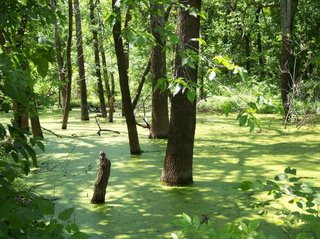
This image shows a bit of swampy area formed when a creek flowing into the Wakarusa is interrupted by a dirt road leading to a nice fishing area.
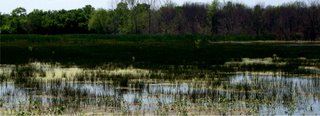
There are a number of maintenance roads, worth hiking along, one of which leads to a new marshy area, quite extensive. We saw great blue herons, unfortunately too far away for me to get pictures.
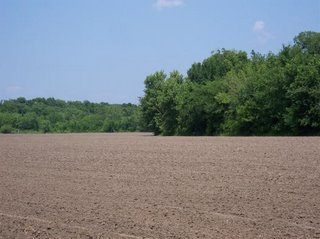


Much of the surrounding land appears to be leased by farmers, who are just planting now. But I don't know what is planted here. We scared up several several snakes. What is really nice here is that you are so far from the main lake that you cannot hear the sounds of cars or motorboats; just the birds.


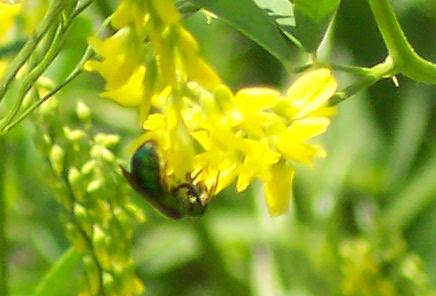
My camera doesn't take good closeups but I end with some buggy pictures. This first one is a sweat bee, I believe an Augochlora, a beautiful metallic green bee. In addition in some of the open areas there were beautiful green tiger beetles, but they were too fast for me to snap.
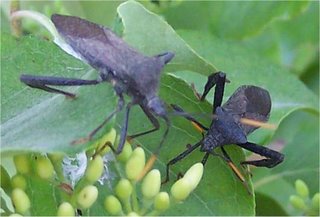


Here are some leaf footed bugs on dogwood. Very impressive bugs indeed; they must have been 3/4 inch long!
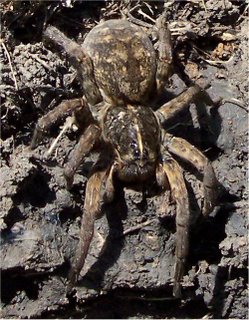


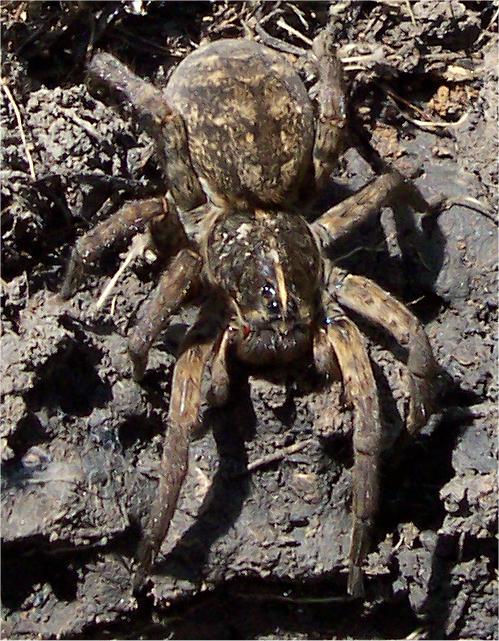
A cool spider we found under a log. I am not sure what kind, but she's pretty good size!


Obviously this part of the lake is not everyone's cup of tea. Indeed if you don't know what this plant is, you probably ought to stay away.
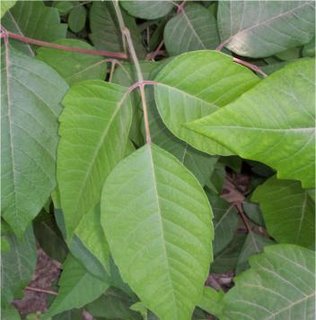
To get to this part of the lake, go south over the dam to County Road 458 and follow that around to the West side of the lake. Just after the second bridge over the main west arm of the lake, 458, jogs left. There is a not too obvious brown sigh that says Clinton Wildlife refuge. Follow 100E South as far as you can go.
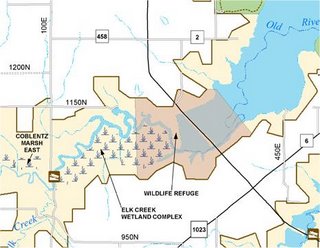


This map shows the spot. We were on the North side of the river around Coblentz marsh. Also the map shows 100 E going over the river but I wouldn't count on that. If you want to go to the boat ramp. Looks like 1023 to 950N is your best bet.

For those not so familiar with the Clinton Lake area and not into the sort of creative driving(As my wife calls it) that I enjoy the complete map is at the Clinton Lake Project home page.


Other links:

http://baldwin-city.com/rec/clintonlake/
Good overview of the Clinton Lake area from the Baldwin City website.

http://douglasnewcomers.lawrence.com/parks.html
Another overview from Douglas County.

http://www.naturalkansas.org/neks.htm
Good maps of areas for wildlife viewing.

http://www.emporia.edu/earthsci/student/schmidt2/wetland.html
A student written review of the Wakarusa Valley and associated regions.

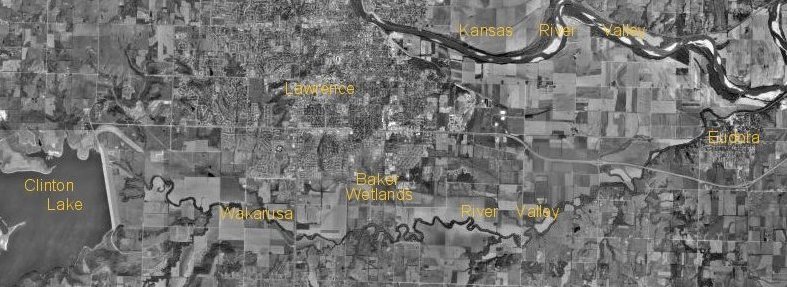
The aerial overview is worth reproducing here:


http://www.kansas.sierraclub.org/Issues/SLT/SouthLawrenceTrafficway.htm
East of Clinton Dam, land use along the Wakarusa is a big issue as this
link from the local Sierra Club discussing the 'South Lawrence Trafficway', shows.


Technorati Tags: