Lately I have been seeing stickers that say "Evolution is a fairy tale for grown-ups. " My first reaction was puzzlement: is this pro or anti-evolution. After all, I do have a soft spot for a good fairy tale. They require imagination, something I value. But of course the slogan is anti-evolution and foisted on the public by people who have no imagination. Now a shadowy group of business people fronted by a Lawrence local concrete magnate, Dave Penny are erecting billboards with this slogan and a link to a pseudoscientific creationist site http://www.scienceprovesit.com/.
Dave Penny has a degree from MIT. Presumably he learned how to think there and is not a stupid person. That being the case I can only conclude he has some sort of delusion and ought to consider therapy, or he is pushing this creationist stuff to further his well known conservative ideological bent, much as the conservative Kansas Board of Education. Some family values: pushing lies to further a political agenda.
So here is my slogan: Creationism: not even a fairy tale. :-)
Other links:
Ex-official helps erect anti-evolution billboard http://www2.ljworld.com/news/2006/mar/23/exofficial_helps_erect_antievolution_billboard/?evolution
Understanding Evolution http://evolution.berkeley.edu/
Is Intelligent Design Science?...OK my own essay and a bit dated but hey its my blog.
http://staff.jccc.net/pdecell/essays/intelldes.html
Technorati Tags:
Kansas
Evolution
Thursday, March 23, 2006


Thursday, March 16, 2006
A new plant!
 My wife made the mistake of asking me to go the plant store to get a plant for a gift. Well that was a mistake. Fortunately I came home with only one plant, aside from the gift. The plant is a so called carnivorous plant, Nephenthes.
Usually nurseries play up the carnivorous aspect and over charge for these plants but this plant was a steal-only $7.00. So inspite of feeling poor, having just paid my bills I plunked down my money.
Doesn't look too interesting until you examine the plant closely and see the the tips of many of the leaves have a pitcher. I had seen pitcher plants in the wild but those are ground dwelling. This guy is an epiphyte as are many orchids and at least in the wild can get pretty good size with 8" pitchers! Shhhh! Don't tell my wife! She already says that my plants attack her.
 What's interesting is that these sorts of pitchers or pitfall traps seems to have evolved independently as a specialization to nitrogen poor habitats in a number of different plant families, and thus represents convergent evolution.
Other links:
International Carnivorous Plant Society
Carnivorous Plants at www.botany.org
Carnivorous Plants at Wayne's Word
"New" data relating to the evolution and phylogeny of some carnivorous plant families
from the ICPS site.
Tuesday, March 14, 2006
a fun meme
What's more fun than reflecting on your past beloved pets and plants? This is courtesy of Nelumba's Garden Blog, where she got it from just go to her site.
#1 What's your earliest memory you have of becoming fascinated with living things- gardens, animals, etc ?
We had a double lot and part of it was let grow semi wild and it was always full of butterflies and had lots of milkweed with these wonderful red longhorn beetles. They would make a squeeking noise when picked up. There were also large dragnflies and my mother would warn me not to try to catch them because they would sew my mouth shut. As for gardening we had an elderly neighbor who gardened and both my sister and I would visit him as he worked in his garden and he would give us fresh vegetables. Mr. Crandell was kind of a "free thinker" and I used to sit with him in the evening and we would talk about plants and animals. He was a big influence on me.
#2 What was your first pet? (I'm adding my own question here- what was your first plant pet?)
Of my own? Do paramecia and brine shrimp count? Actually had a wonderful white cat named snowball. Also had an anole and a spotted salamander.
#3What was your favorite pet?
That is hard!
I guess aside from an Akita I owned as a grad student, probably Snowball. Have also had lots of nice cats in my day. Right now have a 16 year old Siamese with chronic kidney failure.
#1 What's your earliest memory you have of becoming fascinated with living things- gardens, animals, etc ?
We had a double lot and part of it was let grow semi wild and it was always full of butterflies and had lots of milkweed with these wonderful red longhorn beetles. They would make a squeeking noise when picked up. There were also large dragnflies and my mother would warn me not to try to catch them because they would sew my mouth shut. As for gardening we had an elderly neighbor who gardened and both my sister and I would visit him as he worked in his garden and he would give us fresh vegetables. Mr. Crandell was kind of a "free thinker" and I used to sit with him in the evening and we would talk about plants and animals. He was a big influence on me.
#2 What was your first pet? (I'm adding my own question here- what was your first plant pet?)
Of my own? Do paramecia and brine shrimp count? Actually had a wonderful white cat named snowball. Also had an anole and a spotted salamander.
#3What was your favorite pet?
That is hard!
I guess aside from an Akita I owned as a grad student, probably Snowball. Have also had lots of nice cats in my day. Right now have a 16 year old Siamese with chronic kidney failure.
Sunday, March 12, 2006
Kansas weather.

Kansas weather is never boring. This morning around 8:00 I was in the shower when my wife yelled tornado! So grabbed my pants and cell phone as wind came up over the sirens. No damage here but Lawrence was hit pretty hard with what is either a series of microbursts or a tornado. Some pretty good sized trees were knocked down but the damage was very spotty. Right know power is out to much of the city. We are being told to stay home. Good advice since a new set of storms is on the way.
Image/Text/Data from the University of Illinois WW2010 Project. Used with permission.
Other links:
Was it a Tornado?
Microbursts
Tornados
Thursday, March 09, 2006
Lynx

I am getting to hate those funny graphical alphanumeric patterns we use to validate posts in blogger and in other contexts. It seems that the patterns get more and more difficult to handle. Consider the one displayed with this post. I had to really think about the second letter from the right or third letter: is the sequence hm or is it really fim?
Now I have a bit more sympathy with my students who sometimes can't interpret my writing.
That said, pondering these graphics got me wondering, what do the visually impaired do on the web? And that got me fondly remembering Lynx. Lynx for those who don't know is a text based web browser and it was the first web browser I used. At that time, I was a visiting professor at Wasburn U in Topeka and all we had were text terminals. Oh, we could go to the library and use Mosaic's graphics browser but it was so buggy it was not worth it.
Lynx is really compact and fast and even when I finally got a machine with a graphical interface, it was fun to boot the Mac version of Lynx on my Quadra 650 just to see what it would do with my site. My site does not work all that well with Lynx but trying it out with Lynx convinced me that maybe all the frames I was using in my frame happy days probably are not such a good idea. In Lynx you can see the original vision of hypertext that gave rise to what we think of as the web today.
I am pleased to see Lynx still around. Hmmmm supposedly it has been ported to PDA's. Maybe I will see if I can get Lynx for mine.
Other Links:
Blynx: the use of Lynx with speech synthesizers.
Pages enhanced for Lynx: Some of these links don't work, but I see that Kermit lives as well! YES!!!
Web
Water!
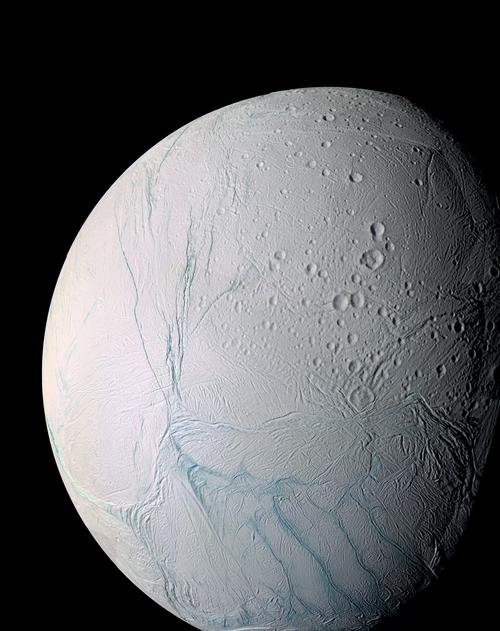 Finally it is really raining here which means that my garden will get water and the salamanders will run. But my yard is not the only place for water. According to NASA the Cassini probe seems to have detected liquid water in a very unlikely place-Saturn's moon Enceladus. The report claims that images from Cassini show plumes of some substance being ejected from moon's surface and the best physical explanation is that the plumes are liquid water from the Enceladus analog of a cold Old Faithful. Quantities of water has been found in other parts of the solar system but to have it so close to the surface, in what is a presumably a very cold part of the solar system, is unusual.
Perhaps Enceladus is a place to look for life, assuming of course the rest of the chemicals for life are present and the heat source is stable.
 Here is how scientists think the water might be produced.
I am not going to get too excited about this but each little discovery of this sort makes it more and more plausible to think that there may be life in other places in the Universe.
Other Links:
Cassini home page
(http://saturn.jpl.nasa.gov/home/index.cfm)
SETI Institute (www.seti.org)
Monday, March 06, 2006
A pop music digression
If you are wondering science and poetry consider this wonderful post from Sandra Porter's Blog: Discovering Biology in a Digital World. Her post is about how plants somehow detect volatile organic compounds given off by other plants when the latter are attacked by insects. The listening plants get advanced warning and mobilize their defenses. But what I really love is the title of the post:
"I hear the cottonwoods whispering above"
Naturally this got my interest
This the first line of a song Tammy sung by Debbie Reynolds in 1957 in the movie "Tammy and the Bachelor"; the lyrics are here and here.
"I hear the cottonwoods whispering above
Tammy! Tammy! Tammy's in love!
The ole hootie owl hootie-hoo's to the dove
Tammy! Tammy! Tammy's in love!
Does my darling feel
What I feel
When he comes near?
My heart beats so joyfully
You'd think that he could hear!"
Wonderful!
The song appears to be widely recorded but I have never heard it.
As an aside the song was composed by Jay Livingston & Ray Evans who wrote many well known standards including:
Mona Lisa and Silver Bells and Que Será, Será. Now those I have heard. Unfortunately most people today may be more familiar with one of their least inspiring efforts, the theme song from the 1960's TV series, Mr. Ed.
Other links:
http://www.lucyfan.com/jaylivingston.html
http://www.answers.com/topic/ray-evans
"I hear the cottonwoods whispering above"
Naturally this got my interest
This the first line of a song Tammy sung by Debbie Reynolds in 1957 in the movie "Tammy and the Bachelor"; the lyrics are here and here.
"I hear the cottonwoods whispering above
Tammy! Tammy! Tammy's in love!
The ole hootie owl hootie-hoo's to the dove
Tammy! Tammy! Tammy's in love!
Does my darling feel
What I feel
When he comes near?
My heart beats so joyfully
You'd think that he could hear!"
Wonderful!
The song appears to be widely recorded but I have never heard it.
As an aside the song was composed by Jay Livingston & Ray Evans who wrote many well known standards including:
Mona Lisa and Silver Bells and Que Será, Será. Now those I have heard. Unfortunately most people today may be more familiar with one of their least inspiring efforts, the theme song from the 1960's TV series, Mr. Ed.
Other links:
http://www.lucyfan.com/jaylivingston.html
http://www.answers.com/topic/ray-evans
Salamander Travels

Lest you think the Lawrence salamander rescuers are an odd lot, a quick Google search using salamander migrations as search terms reveals the following links and tidbits:
Salamander Crossing(http://www.artworking.com/salamander/index.htm) discusses a mass migration of amphibians in Brattleboro Vermont and the activities of salamander rescuers:
"Environmental groups in the region report that a large-scale salamander migration, with creatures numbering in the hundreds, took place during Tuesday evening's rainstorm.
"Some were running right across the road, others were just taking their time," said Betsy Bennett, curator and educator of the Grafton Nature Museum. "We helped some of them across the road when cars came. It was really fun."
As temperatures reached the 50s during the downpour, about 10 local citizens came out to witness the natural spectacle, Bennett said. Museum officials and local residents watched the migration take place at a beaver brook on Townshend Road."

Jug Bay Wetlands Sanctuary near Washington DC (http://www.jugbay.org/jugbay/research/marbled.html) conducts research documenting migrations of the marbled salamander Ambystoma opacum shown in the accompanying picture from their web site.
Karen Luepke (http://www.nmu.edu/biology/Jill/Migration/Migration%20Pages/salamander/index.htm) provides a nice discussion of migration in the spotted salamander, Ambystoma maculatum, along with helpful links. She note several things about salamander migrations. First the migrations are very predictable from year to year and at least for the spotted may require more than just the right weather. Also the salamanders seem to be very faithful to the pond they were born in and never stray far, only to about 200m from the pond.
The Federal Highway Administration reports (http://www.fhwa.dot.gov/environment/wildlifecrossings/salamand.htm) on the building salamander tunnels in Amherst MA, not too far from where I grew up. See also http://www.fhwa.dot.gov/environment/wildlifecrossings/.
As for the homing aspect of migration between the breeding pond and feeding areas, some writers hypothesize a scent component but in newts at least, experimental evidence suggests that magnetic orientation analogous to that used by some birds in migration may be used. See Phillips, JB 1986 Two magnetoreception pathways in a migratory salamander. Science Aug 15;233(4765):765-7 (Abstract). Of course it is quite possible that several different orientation cues are involved.
Subscribe to:
Posts (Atom)