Reference
Friday, May 26, 2006
A Primer on Evo Devo
From Mike the Mad Biologist comes this wonderful review(http://www.nybooks.com/articles/18970) of several books on evolution and development. This is the ideal review, one that not so much reviews the books in question but the reviewers critically examine the concepts and thereby come up with something new.
Reference
Edward Ziff, Israel Rosenfield (May 11, 2006) Evolving Evolution. New York Review of Books 53(8)
Reference
Edward Ziff, Israel Rosenfield (May 11, 2006) Evolving Evolution. New York Review of Books 53(8)


Integrins and animals
In an earlier post I mentioned the idea that animals have an extracellular matrix and that integrins receive information through and about the goings on in the extracellular matrix. Integrins are cell membrane proteins consisting of an alpha subunit and a beta subunit that work together to communicate between the extracellular matrix components. In addition integrins are critical for cell movement and allow cells to move in response to various environmental signals, including mechanical stress (http://www.biophysj.org/cgi/content/full/79/1/144).
Indeed there is actually a complex integrin signaling pathway involved in cell development and movement, the details of which can be found on BioCarta. If you are not familiar with this site, it visually shows important metabolic processes and the human genes associated with the proteins involved in these processes. For instance the integrin signaling pathway shown at BioCarta involves an alpha and beta integrin coded for by the genes ITGA1 and ITGB1.
These two integrin subunits appear to be involved in nerve and collagen regeneration.
To try to gain some insight about integrins, I did a blastp using the alpha and beta subunit amino acid sequences for the proteins coded by the ITGA1 and ITGB1 genes. The alpha subunit gave the following conserved domains:

According to the conserved domain summary, the VWA (red)domains appears to be specific to vertebrates and mediate protein interactions between the extracellular matrix and the cell. Significant alignments are found only in chordates with one exception, namely the green sea urchin-not too suprising since Echinoderms and chordates are believed to be closely related.
The blue domains are called beta propeller repeats and they are characteristic of integrins. These propellers have a sequence of amino acids that repeats seven times. A beta propeller structure is in this figure made with the Cn3D protein structure viewer. These repeats have regions that apparently bind calcium ions, which is interesting since these ions are often involved in signaling, for instance as part of muscle contraction.
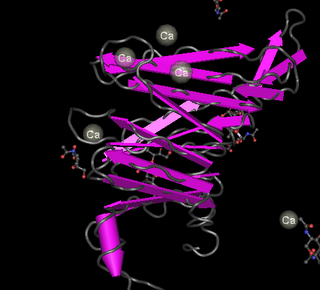 Since I am always suspicious when a protein seems to have no relatives in bacteria I used NCBI's conserved domain feature to look for related architectures and found 66 references to integrin like proteins in bacteria. The function of these proteins in bacteria is not known but at least some are probably cell membrane proteins. See for instance, Nascimento et al (2004), Journal of Bacteriology, p. 2164-2172, discussing the spirochete Leptospira interrogans. The evidence for this is the presence of seven seven FG-GAP repeats that are highly conserved in the beta propeller repeats of integrins.
As pointed out by this article bacteria often form biofilms consisting of other bacteria and various compounds and perhaps integrins evolved in this context.
For the ITGB1 subunit I found a precursor protein sequence (NP_596867) through NCBI and found there is only one conserved domain called INB which is part of the extracellular component of the polypeptide. Here are the similar domains:
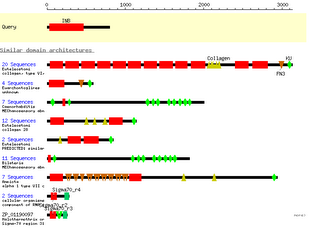
It's interesting that abnormalities in genes for some of the proteins containing some of these domains relate to cellular mechanosensory problems. This makes sense because of the influence the beta subunit has on actin.
The tie in with bacterial proteins gets a bit murky. Most of the related proteins appear to be related to transcription, but one in E. coli may be related to the evolution of it's flagellar mechanism, according to CP Ren et al (J Bacteriol. 2005 Feb;187(4):1430-40)
While there is a lot not known about integrins, it appears that the integrins may not be so unique after all, and that at least in the alpha subunits, we evidence that the genes coding for these proteins can be traced back to the prokaryotes. This is perhaps a similar story to the Homeobox region of the Hox genes involved in animal development being homologous to certain bacterial genes. But that is yet another story, again related to what makes an animal an animal. See the Carroll reference cited below.
References and other links:
Jun Qin, Olga Vinogradova, Edward F. Plow (2004) Integrin Bidirectional Signalling: A Molecular View.
PLoS Biology http://biology.plosjournals.org. 2(6):0726-0729
A good discussion of how integrins send signals into and out of animal cells and the structure of integrins.
E Ruoslahti (1991) Integrins. J Clin Invest. 87(1): 1–5
(http://www.pubmedcentral.nih.gov/articlerender.fcgi?artid=294975&tools=bot)
Clear diagram of the types of interactions between cells and their environment mediated by integrins.
INTEGRIN, ALPHA-1; ITGA1; (OMIM 192968)
http://www.ncbi.nlm.nih.gov/entrez/dispomim.cgi?id=192968
INTEGRIN, BETA-1; (OMIM 135630) ITGB1(http://www.ncbi.nlm.nih.gov/entrez/dispomim.cgi?id=135630)
Carroll, Sean(2005) Endless Forms Most Beautiful, Norton,NY. xi + 350p
I am currently in the middle of this book dealing with the connection between evolution and development or "evo devo". A big theme of this book is that evolution often involves using the same tools in new ways.
Technorati Tags:
Animals
Biology
Proteins
Bioinformatics
Indeed there is actually a complex integrin signaling pathway involved in cell development and movement, the details of which can be found on BioCarta. If you are not familiar with this site, it visually shows important metabolic processes and the human genes associated with the proteins involved in these processes. For instance the integrin signaling pathway shown at BioCarta involves an alpha and beta integrin coded for by the genes ITGA1 and ITGB1.
These two integrin subunits appear to be involved in nerve and collagen regeneration.
To try to gain some insight about integrins, I did a blastp using the alpha and beta subunit amino acid sequences for the proteins coded by the ITGA1 and ITGB1 genes. The alpha subunit gave the following conserved domains:

According to the conserved domain summary, the VWA (red)domains appears to be specific to vertebrates and mediate protein interactions between the extracellular matrix and the cell. Significant alignments are found only in chordates with one exception, namely the green sea urchin-not too suprising since Echinoderms and chordates are believed to be closely related.
The blue domains are called beta propeller repeats and they are characteristic of integrins. These propellers have a sequence of amino acids that repeats seven times. A beta propeller structure is in this figure made with the Cn3D protein structure viewer. These repeats have regions that apparently bind calcium ions, which is interesting since these ions are often involved in signaling, for instance as part of muscle contraction.
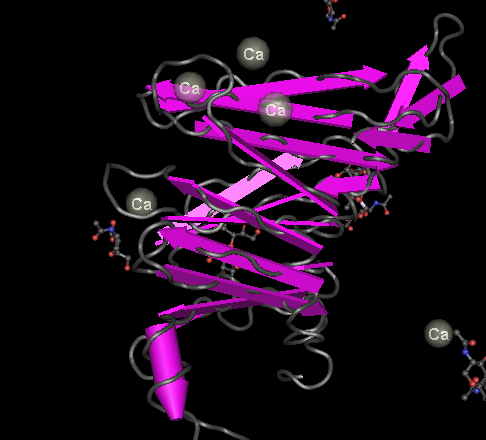 Since I am always suspicious when a protein seems to have no relatives in bacteria I used NCBI's conserved domain feature to look for related architectures and found 66 references to integrin like proteins in bacteria. The function of these proteins in bacteria is not known but at least some are probably cell membrane proteins. See for instance, Nascimento et al (2004), Journal of Bacteriology, p. 2164-2172, discussing the spirochete Leptospira interrogans. The evidence for this is the presence of seven seven FG-GAP repeats that are highly conserved in the beta propeller repeats of integrins.
As pointed out by this article bacteria often form biofilms consisting of other bacteria and various compounds and perhaps integrins evolved in this context.
For the ITGB1 subunit I found a precursor protein sequence (NP_596867) through NCBI and found there is only one conserved domain called INB which is part of the extracellular component of the polypeptide. Here are the similar domains:

It's interesting that abnormalities in genes for some of the proteins containing some of these domains relate to cellular mechanosensory problems. This makes sense because of the influence the beta subunit has on actin.
The tie in with bacterial proteins gets a bit murky. Most of the related proteins appear to be related to transcription, but one in E. coli may be related to the evolution of it's flagellar mechanism, according to CP Ren et al (J Bacteriol. 2005 Feb;187(4):1430-40)
While there is a lot not known about integrins, it appears that the integrins may not be so unique after all, and that at least in the alpha subunits, we evidence that the genes coding for these proteins can be traced back to the prokaryotes. This is perhaps a similar story to the Homeobox region of the Hox genes involved in animal development being homologous to certain bacterial genes. But that is yet another story, again related to what makes an animal an animal. See the Carroll reference cited below.
References and other links:
Jun Qin, Olga Vinogradova, Edward F. Plow (2004) Integrin Bidirectional Signalling: A Molecular View.
PLoS Biology http://biology.plosjournals.org. 2(6):0726-0729
A good discussion of how integrins send signals into and out of animal cells and the structure of integrins.
E Ruoslahti (1991) Integrins. J Clin Invest. 87(1): 1–5
(http://www.pubmedcentral.nih.gov/articlerender.fcgi?artid=294975&tools=bot)
Clear diagram of the types of interactions between cells and their environment mediated by integrins.
INTEGRIN, ALPHA-1; ITGA1; (OMIM 192968)
http://www.ncbi.nlm.nih.gov/entrez/dispomim.cgi?id=192968
INTEGRIN, BETA-1; (OMIM 135630) ITGB1(http://www.ncbi.nlm.nih.gov/entrez/dispomim.cgi?id=135630)
Carroll, Sean(2005) Endless Forms Most Beautiful, Norton,NY. xi + 350p
I am currently in the middle of this book dealing with the connection between evolution and development or "evo devo". A big theme of this book is that evolution often involves using the same tools in new ways.
Technorati Tags:
Animals
Biology
Proteins
Bioinformatics
Monday, May 22, 2006
Religion and Science
Currently I am reading Nicholas Wade's book on the origin and evolution of humans, Before the Dawn- a wonderful book focusing on new insights gleaned from genetic research. What I like about this book is that he does not shy way from sensitive subjects such as the role of warfare in human evolution, the reality of racial differences, or the origin of religion.
About religion Wade develops several arguments, first is the role of religion as a force for social cohesion and this is a fairly standard idea. But then he introduces what to me was a new wrinkle on this argument, building on arguments by late anthropologist Roy Rappaport. Wade argues that the development of language allowed the elaboration of reciprical altruism in human societies. With this elaboration came greater opportunities for 'freeloaders' to cheat the system by deception. There must be "...some context in which statements were reliably and indubitably true."
Wade argues that scared truths which are unverifiable and unfalsifiable along with the communal rituals of religion provide committed individuals with defense "against the lie" and he provides good examples of this aspect of religion operating even today, for instance among Orthodox Jews in the diamond district seal even large contracts with a handshake. So the defense against the the lie allows enhanced trust between members of the community. Presumably repeated participation in the rituals of religion provides a measure of verification that the trust is warranted, making freeloaders easier to detect.
Turning to science, which is too recent a development for Wade to consider, scientists are interested in true statements and having some defense against the lie just as in religion. The difference between science and religion is in the nature of the defense against the lie. In religion that defense is sacred word and ritual (I would submit that this even true in Zen which attempts to get beyond words and rituals. In science the defense is empirical verification. That after all is why scientific results are communicated through a very formal process involving communication not only of conclusions but also the evidence and how that evidence was arrived at. There are freeloaders in science but just as repeated participation in the word and ritual of religion catches many freeloaders, independent verification in science reduces the amount of freeloading in science.
Science and religion are not the same, and this is true even though scientists may at times make metaphysical statements. The difference is best encapsulated with a statement I saw yesterday on a church announcement board on MY way to church:
"Does the clay question the potter?" The implication of the statement seems to be that we should not question God, and that we should be accepting of what gifts we have from God. I have no quibble with that as a religious statement. But of course with the various manufactured controversies in the public mind here in Kansas about evolution, the question takes on an added dimension, whether intended or not. This is because as made abundantly clear by Wade, we are not clay(thought we may have come from clay) and we do question the potter. When other scientists make statements we insist on some sort of empirical verification. So scientists too are concerned about uncovering the freeloader but we rely on experimental evidence and empiricism to be the decider, not adherence to sacred truth and ritual.
So here perhaps the conflict between science and religion cut to its core: a conflict between ways of uncovering the lie. If as Wade argues, the religious impulse is innate and shaped by the evolutionary process, then this may explain the intractability of the the conflict. Scientists often expect that reason and critical thinking will prevail when dealing with Creationism in it's various manifestations, including intelligent design. And yet, it has been my experience that reason and critical do not work when talking with Creationists at least not in the short run. We end up sliding past each other because we are not arguing on the same levels. The Creationist is arguing from an innate emotive level in defense of "sacred truth" and the scientist is arguing what may also be an innate emotive level only this time transferred to a defense of reason and empiricism.
References:
Rappaport, Roy A(1971) Ritual, Sanctity, and Cybernetics,
American Anthropologist, New Series, Vol. 73(1) , pp. 59-76 (abstract)
Wade, Nicholas(2006) Before the Dawn: Recovering the Lost History of Our Ancestors. Penguin Press NY. 312 pp
Other links:
Talk of the Nation, April 28, 2006 · Reporter Nicholas Wade talks about how DNA analysis is rewriting our recent -- and ancient -- history, including a better understanding the evolution of humans. His new book is Before the Dawn: Recovering The Lost History of Our Ancestors.
Science and Spirit (Review of Wade's book).
PLOS Genetics. Turning the Tables: An interview with Nicholas Wade.
Technorati Tags:
Religion
Evolution
Science
Nicholas Wade
About religion Wade develops several arguments, first is the role of religion as a force for social cohesion and this is a fairly standard idea. But then he introduces what to me was a new wrinkle on this argument, building on arguments by late anthropologist Roy Rappaport. Wade argues that the development of language allowed the elaboration of reciprical altruism in human societies. With this elaboration came greater opportunities for 'freeloaders' to cheat the system by deception. There must be "...some context in which statements were reliably and indubitably true."
Wade argues that scared truths which are unverifiable and unfalsifiable along with the communal rituals of religion provide committed individuals with defense "against the lie" and he provides good examples of this aspect of religion operating even today, for instance among Orthodox Jews in the diamond district seal even large contracts with a handshake. So the defense against the the lie allows enhanced trust between members of the community. Presumably repeated participation in the rituals of religion provides a measure of verification that the trust is warranted, making freeloaders easier to detect.
Turning to science, which is too recent a development for Wade to consider, scientists are interested in true statements and having some defense against the lie just as in religion. The difference between science and religion is in the nature of the defense against the lie. In religion that defense is sacred word and ritual (I would submit that this even true in Zen which attempts to get beyond words and rituals. In science the defense is empirical verification. That after all is why scientific results are communicated through a very formal process involving communication not only of conclusions but also the evidence and how that evidence was arrived at. There are freeloaders in science but just as repeated participation in the word and ritual of religion catches many freeloaders, independent verification in science reduces the amount of freeloading in science.
Science and religion are not the same, and this is true even though scientists may at times make metaphysical statements. The difference is best encapsulated with a statement I saw yesterday on a church announcement board on MY way to church:
"Does the clay question the potter?" The implication of the statement seems to be that we should not question God, and that we should be accepting of what gifts we have from God. I have no quibble with that as a religious statement. But of course with the various manufactured controversies in the public mind here in Kansas about evolution, the question takes on an added dimension, whether intended or not. This is because as made abundantly clear by Wade, we are not clay(thought we may have come from clay) and we do question the potter. When other scientists make statements we insist on some sort of empirical verification. So scientists too are concerned about uncovering the freeloader but we rely on experimental evidence and empiricism to be the decider, not adherence to sacred truth and ritual.
So here perhaps the conflict between science and religion cut to its core: a conflict between ways of uncovering the lie. If as Wade argues, the religious impulse is innate and shaped by the evolutionary process, then this may explain the intractability of the the conflict. Scientists often expect that reason and critical thinking will prevail when dealing with Creationism in it's various manifestations, including intelligent design. And yet, it has been my experience that reason and critical do not work when talking with Creationists at least not in the short run. We end up sliding past each other because we are not arguing on the same levels. The Creationist is arguing from an innate emotive level in defense of "sacred truth" and the scientist is arguing what may also be an innate emotive level only this time transferred to a defense of reason and empiricism.
References:
Rappaport, Roy A(1971) Ritual, Sanctity, and Cybernetics,
American Anthropologist, New Series, Vol. 73(1) , pp. 59-76 (abstract)
Wade, Nicholas(2006) Before the Dawn: Recovering the Lost History of Our Ancestors. Penguin Press NY. 312 pp
Other links:
Talk of the Nation, April 28, 2006 · Reporter Nicholas Wade talks about how DNA analysis is rewriting our recent -- and ancient -- history, including a better understanding the evolution of humans. His new book is Before the Dawn: Recovering The Lost History of Our Ancestors.
Science and Spirit (Review of Wade's book).
PLOS Genetics. Turning the Tables: An interview with Nicholas Wade.
Technorati Tags:
Religion
Evolution
Science
Nicholas Wade
Wednesday, May 17, 2006
Medicine, Ethics, and Publishers
Surprise! A study in the recent JAMA (Paul M Ridker, MD; Jose Torres, BA
JAMA. 2006;295:2270-2274. ) found that cardiovascular studies funded by drug companies tended to be biased towards new treatments. This relates to a little ethical problem we have at my school. A publisher of introductory biology texts and laboratory manuals has offered us a great deal: a $2,000 grant if we adapt their package for our introductory course. The grant is to the school for lab supplies and it sounds on the surface like a great deal.
But it bothers me because it seems like we are being pressured to accept this deal at the expense of really looking at other books. Since sometimes I am overly sensitive about such things I asked my wife about the ethics of such things. Can for instance a drug rep tie adaptation of a drug to some sort of favor. Clearly illegal in medicine. How about if the favor is to to the clinic. Still clearly illegal. She pointed out that the situation is much like payola in which DJ's are bribed to play certain songs...again illegal.
Now professors are not quite under the same legal constraints, but it seems to me we are venturing into a ethically problematical area, dealing with something that is legal but not strictly ethical, maybe not all that dissimilar from the situations medical professionals find themselves in, or researchers taking money from private companies to test the efficacy of different therapies.
Technorati Tags:
Teaching
Biology
Ethics
Publishing
JAMA. 2006;295:2270-2274. ) found that cardiovascular studies funded by drug companies tended to be biased towards new treatments. This relates to a little ethical problem we have at my school. A publisher of introductory biology texts and laboratory manuals has offered us a great deal: a $2,000 grant if we adapt their package for our introductory course. The grant is to the school for lab supplies and it sounds on the surface like a great deal.
But it bothers me because it seems like we are being pressured to accept this deal at the expense of really looking at other books. Since sometimes I am overly sensitive about such things I asked my wife about the ethics of such things. Can for instance a drug rep tie adaptation of a drug to some sort of favor. Clearly illegal in medicine. How about if the favor is to to the clinic. Still clearly illegal. She pointed out that the situation is much like payola in which DJ's are bribed to play certain songs...again illegal.
Now professors are not quite under the same legal constraints, but it seems to me we are venturing into a ethically problematical area, dealing with something that is legal but not strictly ethical, maybe not all that dissimilar from the situations medical professionals find themselves in, or researchers taking money from private companies to test the efficacy of different therapies.
Technorati Tags:
Teaching
Biology
Ethics
Publishing
Sunday, May 14, 2006
What is an animal?
This morning a news item on Yahoo caught my eye. The item concerned a fish disease called whirling disease. The disease is caused by a parasite Myxobolus cerebralis belonging to what normally is considered to be a phylum, Myxozoa in the kingdom Protista and I almost filed the article away mentally into the weird fish parasite mental box. But of course I love organisms with strange life cycles so I decided to take a closer look.
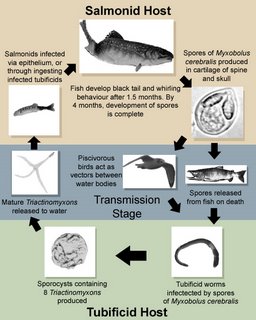
(Myxobolus cerebralis life cycle from http://en.wikipedia.org/wiki/Myxobolus_cerebralis)
As explained at http://www.wildlife.utah.gov/fes/whirling_disease.html, this critter has two hosts, a small annelid worm in the genus Tubifex (See also http://www.esg.montana.edu/aim/annelid/tubtub.html.) and any number of trout or salmon species. The parasite is yet another old world species that has accidentally been introduced to the United States where it causes problems. In this case since our native trout species did not coevolve with the parasite, they are susceptible to it.
Well darn, it doesn't have a really cool complex life cycle involving 20 intermediate hosts, a stage that looks like a ciliate only its photosynthetic , stuff like that. But a Google search turned up a link (http://research.amnh.org/~siddall/myxozoa/myxo.html) that made what to me was a startling claim. Namely that the Myxozoa are not Protista at all but highly reduced parasitic Cnidaria (that is at the risk of oversimplification...Jellyfish.!!!).
OK now this is more like it, but of course I want to see the evidence for this and what other scientists think of this idea. Not all radical ideas in science are reasonable contrary to what people who believe in the paranormal or in intelligent design and other superstitions believe. First, the idea that Myxozoa are related to Cnidaria is supported by the apparent homology between a Myxozoan stage called a polar body and the nematocyst ( a kind of stinging cell in Cnidaria). See Siddall's comparison at http://research.amnh.org/~siddall/myxozoa/cnid_char.html
His phylogeny based both on morphology and ribosomal RNA comparisons places the Myxozoa clearly in the Cnidaria, but I have not examined his data in more detail. In the Tree of Life's Project's phylogeny, the Myxozoa are currently placed as a questionable sister group to the Cnidaria, but firmly in the Metazoa-Metazoa an alternate term for the Kingdom Animalia. See also http://www.palaeos.com/Invertebrates/default.htm
The phylogeny of the Eukaryotes as arranged currently by the Tree of Life Project places the Metazoa and other animals, collared flagellates, Fungi and a group of parasitic organisms called microsporidia all together in a grouping called the Opisthokonts. Opisthokonts have a posterior flagellum in those stages of the life cycle that have motile cells as opposed to an anterior flagellum. Think of the difference between an animal sperm and a Euglena, the latter having an anterior flagellum that pulls the organism through it's medium. Seen in the context of Eukaryote evolution, animals are just part of this larger lineage which is in turn just a small section of eukaryote evolutionary history.
See Armstrong(http://www.bio.ilstu.edu/Armstrong/syllabi/222book/Chapt%203.htm) for a good review of Eukaryote Phylogeny. Indeed we are still trying to make sense of all the different eukaryote groups. Armstrong argues that the 'old' six Kingdom concept no longer is a viable idea since as the relationships between all the lineages becomes clearer the Kingdom Protista does not work for instance because Protista clearly are in the same evolutionary group or clade as plants, but distinct from the other Protista.
This gets into the whole area of cladistics, a method of attempting to reconstruct evolutionary or phylogenetic relationships between different groups of organisms. From the cladistic perspective a natural group has to include the common ancestor of all members of the group and it's descendents.
So what is an animal? Animals generally share or are derived from organisms that share the following characteristics:
There is an interesting discussion at the Berkeley site (http://www.ucmp.berkeley.edu/phyla/metazoamm.html) that makes a very interesting comment. Animal cells ultimately look very different from each other and the only really unique thing that distinguishes all animal cells from cells of other groups are differences in chemistry and metabolism. I have already mentioned that animal cells don't use and metabolize cellulose and this link notes that animal cells have a complex extracellular matrix made of glycoproteins, collagen. This extracellular matrix is important in animal cell adhesion, communication and development. In a sense, the extracellular matrix, mediates between the cell and it's surroundings. Indeed, all animals appear to have specialized protein receptors called integrins in their cell membranes that receive signals through and about the extracellular matrix.
Integrins are found in some Protista apparently (See http://receptome.stanford.edu/HPMR/Families/Frameset_family.asp?FamId=5&ProtType=Receptor)
but in animals they have a role in adhesion not found in Protists. So it seems that if one wants to look more closely at the origin of animals maybe these would be good proteins to examine.
So check back later this week for Part 2 of What is an animal...BLASTING for integrins.
Other links:
Myxozoan Network (http://www.iats.csic.es/~patolog2/about.htm)
The New Animal Phylogeny: Reliability and Implications
( http://www.pnas.org/cgi/content/full/97/9/4453)
Palaeos. (http://www.palaeos.com/Default.htm)
Evaluating hypotheses of basal animal phylogeny using complete sequences of large and small subunit rRNA (http://www.pnas.org/cgi/content/full/98/17/9707)
Technorati Tags:
Animals
Biology

(Myxobolus cerebralis life cycle from http://en.wikipedia.org/wiki/Myxobolus_cerebralis)
As explained at http://www.wildlife.utah.gov/fes/whirling_disease.html, this critter has two hosts, a small annelid worm in the genus Tubifex (See also http://www.esg.montana.edu/aim/annelid/tubtub.html.) and any number of trout or salmon species. The parasite is yet another old world species that has accidentally been introduced to the United States where it causes problems. In this case since our native trout species did not coevolve with the parasite, they are susceptible to it.
Well darn, it doesn't have a really cool complex life cycle involving 20 intermediate hosts, a stage that looks like a ciliate only its photosynthetic , stuff like that. But a Google search turned up a link (http://research.amnh.org/~siddall/myxozoa/myxo.html) that made what to me was a startling claim. Namely that the Myxozoa are not Protista at all but highly reduced parasitic Cnidaria (that is at the risk of oversimplification...Jellyfish.!!!).
OK now this is more like it, but of course I want to see the evidence for this and what other scientists think of this idea. Not all radical ideas in science are reasonable contrary to what people who believe in the paranormal or in intelligent design and other superstitions believe. First, the idea that Myxozoa are related to Cnidaria is supported by the apparent homology between a Myxozoan stage called a polar body and the nematocyst ( a kind of stinging cell in Cnidaria). See Siddall's comparison at http://research.amnh.org/~siddall/myxozoa/cnid_char.html
His phylogeny based both on morphology and ribosomal RNA comparisons places the Myxozoa clearly in the Cnidaria, but I have not examined his data in more detail. In the Tree of Life's Project's phylogeny, the Myxozoa are currently placed as a questionable sister group to the Cnidaria, but firmly in the Metazoa-Metazoa an alternate term for the Kingdom Animalia. See also http://www.palaeos.com/Invertebrates/default.htm
The phylogeny of the Eukaryotes as arranged currently by the Tree of Life Project places the Metazoa and other animals, collared flagellates, Fungi and a group of parasitic organisms called microsporidia all together in a grouping called the Opisthokonts. Opisthokonts have a posterior flagellum in those stages of the life cycle that have motile cells as opposed to an anterior flagellum. Think of the difference between an animal sperm and a Euglena, the latter having an anterior flagellum that pulls the organism through it's medium. Seen in the context of Eukaryote evolution, animals are just part of this larger lineage which is in turn just a small section of eukaryote evolutionary history.
See Armstrong(http://www.bio.ilstu.edu/Armstrong/syllabi/222book/Chapt%203.htm) for a good review of Eukaryote Phylogeny. Indeed we are still trying to make sense of all the different eukaryote groups. Armstrong argues that the 'old' six Kingdom concept no longer is a viable idea since as the relationships between all the lineages becomes clearer the Kingdom Protista does not work for instance because Protista clearly are in the same evolutionary group or clade as plants, but distinct from the other Protista.
This gets into the whole area of cladistics, a method of attempting to reconstruct evolutionary or phylogenetic relationships between different groups of organisms. From the cladistic perspective a natural group has to include the common ancestor of all members of the group and it's descendents.
So what is an animal? Animals generally share or are derived from organisms that share the following characteristics:
- Animals are multicellular, usually with well differentiated tissues. But not always!
- Animals are generally diploid and produce haploid gametes via meiosis. In contrast plants produce spores by meiosis and gametes from haploid multicellular stages via mitosis.
- Animals are heterotrophic or more precisely chemoheterotrophs meaning that they get their energy and carbon from complex organic substances-hamburgers for instance.
- Animals cells do not have cell walls and animals are unable to digest cellulose, unlike many protists and bacteria. In fact those animals that ingest cellulose such as termites rely on a complex assemblage of single celled organisms in their gut to digest cellulose.
- Animals produce a diploid zygote from sexual reproduction involving the sperm and the egg and the zygote generally develops into a multicellular larval stage which primitively is free living.
There is an interesting discussion at the Berkeley site (http://www.ucmp.berkeley.edu/phyla/metazoamm.html) that makes a very interesting comment. Animal cells ultimately look very different from each other and the only really unique thing that distinguishes all animal cells from cells of other groups are differences in chemistry and metabolism. I have already mentioned that animal cells don't use and metabolize cellulose and this link notes that animal cells have a complex extracellular matrix made of glycoproteins, collagen. This extracellular matrix is important in animal cell adhesion, communication and development. In a sense, the extracellular matrix, mediates between the cell and it's surroundings. Indeed, all animals appear to have specialized protein receptors called integrins in their cell membranes that receive signals through and about the extracellular matrix.
Integrins are found in some Protista apparently (See http://receptome.stanford.edu/HPMR/Families/Frameset_family.asp?FamId=5&ProtType=Receptor)
but in animals they have a role in adhesion not found in Protists. So it seems that if one wants to look more closely at the origin of animals maybe these would be good proteins to examine.
So check back later this week for Part 2 of What is an animal...BLASTING for integrins.
Other links:
Myxozoan Network (http://www.iats.csic.es/~patolog2/about.htm)
The New Animal Phylogeny: Reliability and Implications
( http://www.pnas.org/cgi/content/full/97/9/4453)
Palaeos. (http://www.palaeos.com/Default.htm)
Evaluating hypotheses of basal animal phylogeny using complete sequences of large and small subunit rRNA (http://www.pnas.org/cgi/content/full/98/17/9707)
Technorati Tags:
Animals
Biology
Friday, May 12, 2006
New poem.
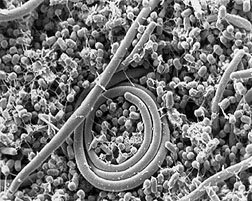
I haven't had as much time to write poetry this year, something I hope to rectify this summer. So here is a poem actually dedicated to the creationists amongst us that they will become able to hear the conversation of life that is taking place all around us. The poem appears with others on my poetry site, Green Fuse Poetry.
(image from http://www.ars.usda.gov/is/AR/archive/jan00/bact0100.htm)
This poem is inspired by new findings that bacteria actually communicate with each other chemically and often this communication may be between very different species of bacteria that are part of a biofilm. For instance see http://www.jci.org/cgi/content/full/112/9/1288.
Also at the time we had a spate of controversy concerning the teaching of evolution and the press coverage of this controversy in Kansas (http://theforcethat.blogspot.com/2006/05/on-bulldogs-and-politics-of.html) and the two seeming disconnected ideas - bacteria talking and the evolution controversy just made a certain poetic sense to combine. The result is the poem that follows:
__________________________________________________
Thinking Himself Wise
One long conversation
Me with you and you with the Earth
And the Earth with the Sun
Began with the simplest lines
Joining and breaking words
Without any intention.
The simple begets the complex
And in talking can beget the simple again
Or flow into another conversation,
To, in the ebb and flow of the talk
Become complex
Rising haughty and flush
And deaf to the conversations
In the soil beneath his feet.
Copyright © Paul Decelles May 11, 2006
Other links:
Bacterial Communication and Group Behavior
New Salmonella finding: Inter-bacterial Communication!
Technorati Tags:
Poetry
Bacteria
Wednesday, May 10, 2006
The two cultures
A good quote from Jeff Immelt, CEO of General Electric.
"At a macro level, I think learning is going to bifurcate society. You're going to see people who want to keep learning, especially about scientific or technical things. They're going to be fine. But those who don't are going to be left behind. There's going to be a broad separation of opportunities between those who keep learning and those who don't."
We know he is right, so why do will continuously send the wrong message to ourselves as a society?
http://www.ge.com/en/company/
Technorati Tags:
Education
"At a macro level, I think learning is going to bifurcate society. You're going to see people who want to keep learning, especially about scientific or technical things. They're going to be fine. But those who don't are going to be left behind. There's going to be a broad separation of opportunities between those who keep learning and those who don't."
We know he is right, so why do will continuously send the wrong message to ourselves as a society?
http://www.ge.com/en/company/
Technorati Tags:
Education
Tuesday, May 09, 2006
Blogs for student presentations
My genetics students are required to do a web project and presentation and one of my students decided to use blogger for presenting her project. She had started out using html but found blogger a quick and easy way to get a nice presentation without a lot of fuss.
Check out her project at http://ermasmit.blogspot.com/
She might even appraciate comments.
Technorati Tags:
Genetics
Education
Blogging
Check out her project at http://ermasmit.blogspot.com/
She might even appraciate comments.
Technorati Tags:
Genetics
Education
Blogging
Subscribe to:
Posts (Atom)