I heard the expression snakes on a plane the other week and being etymologically oriented as well as entomologically oriented, I had to check this new phrase out. According to Urbandictionary.com, "snakes on a plane" means something around "Cest la vie",and "Shit happens" and the phrase relates to a working title for a movie of the same name, and popularized by a screenwriter Josh Friedman in his blog, http://hucksblog.blogspot.com in an entry protesting a proposed change in the title of the movie. Friedman explains his ire about the change in an entry you can read for yourself. Warning, if you don't like certain four letter words, you might want to be content with this quote
"In fact, during the two or three days that precedes my phone call with the studio, I become obsessed with the concept. Not as a movie. But as a sort of philosophy. Somewhere in between "Cest la vie", "Whattya gonna do?" and "Shit happens" falls my new zen koan "Snakes on a Plane".
WIFE: "Honey you stepped in dog poop again. "
ME: "Snakes on a Plane..."
DOCTOR: "Your cholesterol is 290. Perhaps you want to mix in a walk once in a while."
ME: "Snakes on a Plane..."
WIFE: "Honey while you were on your cholesterol walk you stepped in dog poop again." "
Now what is this exaptation stuff? Exaptation is the evolution of new adaptations from adaptations that evolved in a different context. For example, leaves which evolved mainly as organs that carry out photosynthesis, become thorns in cacti and become adaptations that protect the cacti from grazing animals.
So today I used "snakes in a plane" to illustrate a parallel between cultural and biological evolution. The "snake" is a basically a cultural exaptation-from a movie title to a phrase meaning "that's life or "s__t happens". OK I am don't use scatological terms usually..I might quote them but will not use them. Some biologists view cultural evolution as having a close correspondence with biological evolution. I think the analogy is going a bit too far, but ideas do seem to take on a life of their own, meanings become exapted (perhaps coopted), and the results of this maybe quite creative and unexpected. That is one of the fun things about language and one of the fun things about the results of biological evolution!
Other links:
http://evolution.berkeley.edu/evosite/evo101/IIIE5cExaptations.shtml
This reference defines an exaptation as being slightly different than an adaptation. An adaptation is a feature produced by natural selection for its current function and an exaptation is a feature that evolved for some other function other than its current function-so the feature is co-opted by natural selection for a new function. So feathers are an adaptation for insulation but an exaptation for flight. See:
http://evolution.berkeley.edu/evosite/evo101/IIIE5dQualifying.shtml
Personally I think that this is a bit of an artificial distinction and I prefer to think of exaptations as a particular type of adaptation. After all given the tendency of evolution to reuse and reshape existing features, there is a certain sense that most adaptations involve exaptation. See for instance: http://plato.stanford.edu/entries/teleology-biology/, which views the distinction between adaptation and exaptation as as merely a technical one, a matter of taste.
Here is a fun explanation of exaptation in terms of the Jerry rigged solution used to save Apollo 13:
http://joolya.blogspot.com/2006/01/exaptation_19.html
Technorati Tags:
Evolution
Biology
language
Wednesday, April 26, 2006


Friday, April 21, 2006
The Low Down on 420
Today my 10:00 class had a lot of absences. When I asked my students if something was going on, one replied that maybe people were wasted from yesterday. Why yesterday I asked? The reply came: "420". What's that? A student explained that 4/20 was a day to smoke pot and that it also had some connection with Columbine and was some sort of police code when they were going to make a bust.
Well the truth is a bit less interesting. According to www.snopes.com, (http://www.snopes.com/language/stories/420.htm), the authority on urban legends and slang, "420" began among a group of high schoolers to signify the time of day when they could light up...and I don't mean cigs either. Somehow this spread and the meaning shifted to the date April 20 rather than 4:20 pm aided by an unfortunate set of coincidences; for instance 4/20 is the birth day of Hitler and yes it was the day of the Columbine massacre.
All the other baggage supposedly related to 420- that is some sort of police code is not true. Oh yes Albert Hofmann took his first intentional LSD trip at 4:20 on 19 April 1943, having previously accidently taking LSD isolated from the fungus that produced it.
So have a nice 420 tommorrow, whatever your trip.
Other links:
A Conversation with Albert Hoffmann http://www.maps.org/news-letters/v08n3/08330hof.html
NIDA Infofacts: LSD(http://www.nida.nih.gov/Infofacts/LSD.html) You trust the government right?
Well the truth is a bit less interesting. According to www.snopes.com, (http://www.snopes.com/language/stories/420.htm), the authority on urban legends and slang, "420" began among a group of high schoolers to signify the time of day when they could light up...and I don't mean cigs either. Somehow this spread and the meaning shifted to the date April 20 rather than 4:20 pm aided by an unfortunate set of coincidences; for instance 4/20 is the birth day of Hitler and yes it was the day of the Columbine massacre.
All the other baggage supposedly related to 420- that is some sort of police code is not true. Oh yes Albert Hofmann took his first intentional LSD trip at 4:20 on 19 April 1943, having previously accidently taking LSD isolated from the fungus that produced it.
So have a nice 420 tommorrow, whatever your trip.
Other links:
A Conversation with Albert Hoffmann http://www.maps.org/news-letters/v08n3/08330hof.html
NIDA Infofacts: LSD(http://www.nida.nih.gov/Infofacts/LSD.html) You trust the government right?
Tuesday, April 18, 2006
What's in bloom...
Been very busy but just thought I would post some pictures from my garden. I am not a big tulip fan but this year the tulips seem much more intense...
 For instance these pink ones...
or my favorite these red ones. I like them because they remind me of some of those intense red flowering desert cacti..the kind I do not have in my collection:

and next is this yellow and red variety:

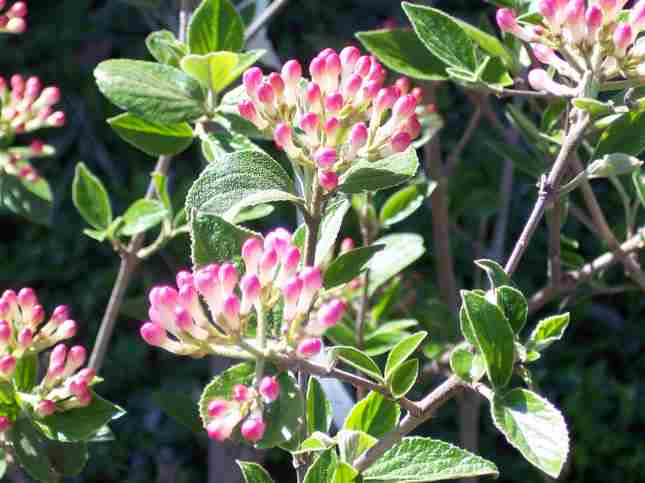
Some of my favorite flowers are more subtle such as this white flowering viburnum, not yet open, growing on the north side of my house. I love the subtle pink of the unopened blossoms:

Of course what is gardening without a little excitement in the form of this tough little snake:

 For instance these pink ones...
or my favorite these red ones. I like them because they remind me of some of those intense red flowering desert cacti..the kind I do not have in my collection:

and next is this yellow and red variety:

Some of my favorite flowers are more subtle such as this white flowering viburnum, not yet open, growing on the north side of my house. I love the subtle pink of the unopened blossoms:
Of course what is gardening without a little excitement in the form of this tough little snake:

Wednesday, April 05, 2006
Transitional fossils and creationist superstition
A constant creationist claim is that there are no transitional fossils. And yet as palaentologists will tell you the fossil record is full of transitional forms-indeed as Larry Martin at the University of Kansas puts it "My drawers are crawling with transitional forms". Now the creationists do have a technical point-namely one cannot PROVE that a certain fossil that appears to be transitional really is the direct ansestor of another species.
But the more one looks, the more transitions one sees, to the point where the creationist'c claim strains comon sense. The latest transitional form (Tiktaalik roseae) reported in Nature (http://www.nature.com/nature/journal/v440/n7085/edsumm/e060406-01.html)
fills in a critical gap between fish and land vertebrates.
As Dr. Michael J. Novacek from the American Museum of Natural History noted:
"We've got Archaeopteryx, an early whale that lived on land and now this animal showing the transition from fish to tetrapod. What more do we need from the fossil record to show that the creationists are flatly wrong?"
How many more indeed.
Other Links and additional comments:
Scientists Call Fish Fossil the 'Missing Link'
http://www.nytimes.com/2006/04/05/science/05cnd-fossil.html?ei=5094&en=fe3427d67e965e46&hp=&ex=1144296000&partner=homepage&pagewanted=all
Graphic from The Times: http://www.timesonline.co.uk/article/0,,11069-2120609,00.html
Was Darwin Wrong? http://magma.nationalgeographic.com/ngm/0411/feature1/fulltext.html
Transitional Fossils. http://www.origins.tv/darwin/transitionals.htm
List if Transitional Fossils.http://www.answers.com/topic/list-of-transitional-fossils
Transitional Forms: http://www.indiana.edu/~oso/evolution/teaching/te2a.htm
Also see this page (http://www.indiana.edu/~oso/evolution/transitions/t3k.html#1) from the Indiana site that shows two alternative predictions as to what transitional forms should be like. First is the popular conception that all traits change in parallel and a model of transitional form evolution based on modern genetics. This model predicts that different traits will change at different times so that transitional forms should be a mosaic of ancestral and derived characteristics. The new transitional form is the sort of mosaic as predicted by modern theory:
"Like its immediate ancestors, Tiktaalik is scaly and displays gill and fin features that indicate it lived mostly in the water. But it lost its gill cover and its snout grew, suggesting that changes were under way in the creature's breathing mechanism and in its food sources. It boasts a heftier rib cage than its ancestors, presumably to support it when it leaves the water. It's skull has lost related bones associated with fish but missing in tetrapods. Another gill feature, a tiny slit that became part of the ear in tetrapods, has grown wider. And the bones in the fins along its sides point to proto-limbs with enough strength and flexibility at the shoulder, elbow, and wrist to allow Tiktaalik to lift itself off the bottom and perhaps temporarily move about on land."
from http://www.csmonitor.com/2006/0406/p02s01-stss.html
Technorati Tags:
Evolution
But the more one looks, the more transitions one sees, to the point where the creationist'c claim strains comon sense. The latest transitional form (Tiktaalik roseae) reported in Nature (http://www.nature.com/nature/journal/v440/n7085/edsumm/e060406-01.html)
fills in a critical gap between fish and land vertebrates.
As Dr. Michael J. Novacek from the American Museum of Natural History noted:
"We've got Archaeopteryx, an early whale that lived on land and now this animal showing the transition from fish to tetrapod. What more do we need from the fossil record to show that the creationists are flatly wrong?"
How many more indeed.
Other Links and additional comments:
Scientists Call Fish Fossil the 'Missing Link'
http://www.nytimes.com/2006/04/05/science/05cnd-fossil.html?ei=5094&en=fe3427d67e965e46&hp=&ex=1144296000&partner=homepage&pagewanted=all
Graphic from The Times: http://www.timesonline.co.uk/article/0,,11069-2120609,00.html
Was Darwin Wrong? http://magma.nationalgeographic.com/ngm/0411/feature1/fulltext.html
Transitional Fossils. http://www.origins.tv/darwin/transitionals.htm
List if Transitional Fossils.http://www.answers.com/topic/list-of-transitional-fossils
Transitional Forms: http://www.indiana.edu/~oso/evolution/teaching/te2a.htm
Also see this page (http://www.indiana.edu/~oso/evolution/transitions/t3k.html#1) from the Indiana site that shows two alternative predictions as to what transitional forms should be like. First is the popular conception that all traits change in parallel and a model of transitional form evolution based on modern genetics. This model predicts that different traits will change at different times so that transitional forms should be a mosaic of ancestral and derived characteristics. The new transitional form is the sort of mosaic as predicted by modern theory:
"Like its immediate ancestors, Tiktaalik is scaly and displays gill and fin features that indicate it lived mostly in the water. But it lost its gill cover and its snout grew, suggesting that changes were under way in the creature's breathing mechanism and in its food sources. It boasts a heftier rib cage than its ancestors, presumably to support it when it leaves the water. It's skull has lost related bones associated with fish but missing in tetrapods. Another gill feature, a tiny slit that became part of the ear in tetrapods, has grown wider. And the bones in the fins along its sides point to proto-limbs with enough strength and flexibility at the shoulder, elbow, and wrist to allow Tiktaalik to lift itself off the bottom and perhaps temporarily move about on land."
from http://www.csmonitor.com/2006/0406/p02s01-stss.html
Technorati Tags:
Evolution
Wednesday, March 29, 2006
Pleo: new life form?
While prowling around the web, I found a link to a new robot toy called Pleo. Pleo is a robot produced by a company called Ugobe and is a robot model of a one week old Camarasaurus, a dinosaur from the Jurassic period. The web site claims:
" Pleo is a 'designer species'. He incorporates all the basic traits of autonomous life. He is specifically engineered and enhanced to mimic life and relate to his owner on a personal level. "
and further that:
"Pleo is capable of expression. He can feel joy and sorrow, anger and annoyance. When Pleo is tired, he will become drowsy and go to sleep, even dream. Two or more Pleos will recognize one another. Be careful though. They can transmit colds to each other. Achoo! Pleo even sneezes!"
Now I am not a vitalist, I believe it one day will be possible to create artificial life forms but Pleo is a poor mechanical analog for the sort of nervous system/hormonal controls involved in real emotion. Is Pleo a nice toy? Looks it to me and at less than $200 I bet Ugobe sells a lot of them. To claim that Pleo is aware, and shows emotion is a bit of stretch. Can you spell anthropomorphism?
Pleo does have some impressive capabilities (video) and one could argue some of the characteristics of life. It even seems capable of some limited learning about its surroundings, but it is qualitatively quite a different thing than an organism. Now when it is able to reproduce and maintain itself then I will change my mind.
Other links:
Ugobe
(http://www.ugobe.com/home.html)
Meet Pleo, descendent of furby
(http://blogs.zdnet.com/BTL/wp-trackback.php?p=2542)
" Pleo is a 'designer species'. He incorporates all the basic traits of autonomous life. He is specifically engineered and enhanced to mimic life and relate to his owner on a personal level. "
and further that:
"Pleo is capable of expression. He can feel joy and sorrow, anger and annoyance. When Pleo is tired, he will become drowsy and go to sleep, even dream. Two or more Pleos will recognize one another. Be careful though. They can transmit colds to each other. Achoo! Pleo even sneezes!"
Now I am not a vitalist, I believe it one day will be possible to create artificial life forms but Pleo is a poor mechanical analog for the sort of nervous system/hormonal controls involved in real emotion. Is Pleo a nice toy? Looks it to me and at less than $200 I bet Ugobe sells a lot of them. To claim that Pleo is aware, and shows emotion is a bit of stretch. Can you spell anthropomorphism?
Pleo does have some impressive capabilities (video) and one could argue some of the characteristics of life. It even seems capable of some limited learning about its surroundings, but it is qualitatively quite a different thing than an organism. Now when it is able to reproduce and maintain itself then I will change my mind.
Other links:
Ugobe
(http://www.ugobe.com/home.html)
Meet Pleo, descendent of furby
(http://blogs.zdnet.com/BTL/wp-trackback.php?p=2542)
Tuesday, March 28, 2006
What are we?
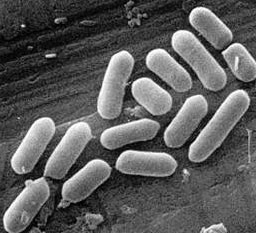
When we think of ourselves as organisms, we think of ourselves as being unified, for instance as a eukaryotic organism. But an article in Live Science's "Bad Medicine" reminds us that we are quite different than we think we are. In particular, prokaryotic cells, mainly bacteria, in our body, outnumber our 'human' cells about 10:1. Nor are these bacteria just interlopers to be eliminated by antibiotics or scrubbed away by antibacterial soap.
image from NASA: http://weboflife.nasa.gov/slstp/blustein.htm
Our gut is lined with bacteria which are involved in digestion and in the production of key nutrients. Further by having our own friendly bacteria we are protected from pathogenic bacteria that would otherwise find our bodies great pickings. These friendly bacteria are symbiotic with us. They and we evolved together and the result is mutually beneficial to both us and the bacteria.
So in a sense we really are not a single organism but a whole community of organisms that need each other. This notion maybe unsettling to some, but I find it strangely comforting that the interdependence of organisms on the Earth is reflected in the interdependence of the wildly different organisms that comprise the community of our bodies.
Other links:
War on Bacteria is Wrongheaded.
http://www.livescience.com/humanbiology/060328_bad_bacterial.html
Double Bonus: Bacteria Eat Pollution, Generate Electricity.
http://www.livescience.com/technology/050607_bacteria_electricity.html
How to Live Long and Prosper: Get Dirty?
http://www.livescience.com/humanbiology/041013_longevity_flies.html
The Rise of Antibiotic Resistant Infections.
http://www.fda.gov/fdac/features/795_antibio.html
Bacteria-Animal Symbiosis Site.
http://web.uconn.edu/mcbstaff/graf/Sym.html
Technorati Tags:
Evolution
Symbiosis
Bacteria
Monday, March 27, 2006
What is good for the goose is good for the platypus...
An anonymous poster commented:
"Not defining evolution and then saying "it" is based on facts and physical evidence without stating such doesn't sound very scientific to me."
I am glad anonymous asked, because there seems to be a lot of confusion in the popular mind about what a biologist means when referrring to biological evolution.
"Not defining evolution and then saying "it" is based on facts and physical evidence without stating such doesn't sound very scientific to me."
I am glad anonymous asked, because there seems to be a lot of confusion in the popular mind about what a biologist means when referrring to biological evolution.
Evolution as a word has a number of meanings, some more general than others. The most general meaning of the word is change through time. But when referring to biological evolution perhaps the most common today is that biological evolution(the type creating all the fuss) can be defined simply as
The National Academy of Science(1998) defines evolution as:
"..change in the hereditary characteristics of groups of organisms over the course of generations. (Darwin referred to this process as "descent with modification.")"
Note the reference to Darwin's geneological definition as descent with modification.
So biological evolution is not really about species but how about the genetic make up of populations and how this changes over time. This definition can be used to model and empircally test hypotheses about HOW evolution operates. It is after a conceptually trivial problem to demonstrate that biological evolution happens, I suggest a trip to the Science library on this point. So the issue for the scientist is explaining how evolution operates in different situations. Again a trip to your friendly neighborhood science library might be useful.
Incidentally this definition does not refer to the origin of life problem or the "big bang" or any of the other obfuscations creationists try to use when dealing with evolution.
I wonder what the definition of intelligent design is. Can IT be specifies in a way that allows empirical tests as to HOW intelligent design operates? How about creationism: can IT be defined in a way that allows empirical testing of the mechanisms of creationism? We can do that with evolution. Come on...after all what is good for the goose is good for the platypus.
Teaching about Evolution and the Nature of Science
http://www.nap.edu/books/0309063647/html/index.html
Technorati Tags:
Kansas
Evolution
Creationism
Saturday, March 25, 2006
Another cool biology blog
For a biology blog with some political bite you might want to visit Mike the Mad Biologist.
Subscribe to:
Posts (Atom)