While prowling around the web, I found a link to a new robot toy called Pleo. Pleo is a robot produced by a company called Ugobe and is a robot model of a one week old Camarasaurus, a dinosaur from the Jurassic period. The web site claims:
" Pleo is a 'designer species'. He incorporates all the basic traits of autonomous life. He is specifically engineered and enhanced to mimic life and relate to his owner on a personal level. "
and further that:
"Pleo is capable of expression. He can feel joy and sorrow, anger and annoyance. When Pleo is tired, he will become drowsy and go to sleep, even dream. Two or more Pleos will recognize one another. Be careful though. They can transmit colds to each other. Achoo! Pleo even sneezes!"
Now I am not a vitalist, I believe it one day will be possible to create artificial life forms but Pleo is a poor mechanical analog for the sort of nervous system/hormonal controls involved in real emotion. Is Pleo a nice toy? Looks it to me and at less than $200 I bet Ugobe sells a lot of them. To claim that Pleo is aware, and shows emotion is a bit of stretch. Can you spell anthropomorphism?
Pleo does have some impressive capabilities (video) and one could argue some of the characteristics of life. It even seems capable of some limited learning about its surroundings, but it is qualitatively quite a different thing than an organism. Now when it is able to reproduce and maintain itself then I will change my mind.
Other links:
Ugobe
(http://www.ugobe.com/home.html)
Meet Pleo, descendent of furby
(http://blogs.zdnet.com/BTL/wp-trackback.php?p=2542)
Wednesday, March 29, 2006


Tuesday, March 28, 2006
What are we?
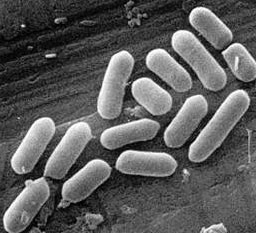
When we think of ourselves as organisms, we think of ourselves as being unified, for instance as a eukaryotic organism. But an article in Live Science's "Bad Medicine" reminds us that we are quite different than we think we are. In particular, prokaryotic cells, mainly bacteria, in our body, outnumber our 'human' cells about 10:1. Nor are these bacteria just interlopers to be eliminated by antibiotics or scrubbed away by antibacterial soap.
image from NASA: http://weboflife.nasa.gov/slstp/blustein.htm
Our gut is lined with bacteria which are involved in digestion and in the production of key nutrients. Further by having our own friendly bacteria we are protected from pathogenic bacteria that would otherwise find our bodies great pickings. These friendly bacteria are symbiotic with us. They and we evolved together and the result is mutually beneficial to both us and the bacteria.
So in a sense we really are not a single organism but a whole community of organisms that need each other. This notion maybe unsettling to some, but I find it strangely comforting that the interdependence of organisms on the Earth is reflected in the interdependence of the wildly different organisms that comprise the community of our bodies.
Other links:
War on Bacteria is Wrongheaded.
http://www.livescience.com/humanbiology/060328_bad_bacterial.html
Double Bonus: Bacteria Eat Pollution, Generate Electricity.
http://www.livescience.com/technology/050607_bacteria_electricity.html
How to Live Long and Prosper: Get Dirty?
http://www.livescience.com/humanbiology/041013_longevity_flies.html
The Rise of Antibiotic Resistant Infections.
http://www.fda.gov/fdac/features/795_antibio.html
Bacteria-Animal Symbiosis Site.
http://web.uconn.edu/mcbstaff/graf/Sym.html
Technorati Tags:
Evolution
Symbiosis
Bacteria
Monday, March 27, 2006
What is good for the goose is good for the platypus...
An anonymous poster commented:
"Not defining evolution and then saying "it" is based on facts and physical evidence without stating such doesn't sound very scientific to me."
I am glad anonymous asked, because there seems to be a lot of confusion in the popular mind about what a biologist means when referrring to biological evolution.
"Not defining evolution and then saying "it" is based on facts and physical evidence without stating such doesn't sound very scientific to me."
I am glad anonymous asked, because there seems to be a lot of confusion in the popular mind about what a biologist means when referrring to biological evolution.
Evolution as a word has a number of meanings, some more general than others. The most general meaning of the word is change through time. But when referring to biological evolution perhaps the most common today is that biological evolution(the type creating all the fuss) can be defined simply as
The National Academy of Science(1998) defines evolution as:
"..change in the hereditary characteristics of groups of organisms over the course of generations. (Darwin referred to this process as "descent with modification.")"
Note the reference to Darwin's geneological definition as descent with modification.
So biological evolution is not really about species but how about the genetic make up of populations and how this changes over time. This definition can be used to model and empircally test hypotheses about HOW evolution operates. It is after a conceptually trivial problem to demonstrate that biological evolution happens, I suggest a trip to the Science library on this point. So the issue for the scientist is explaining how evolution operates in different situations. Again a trip to your friendly neighborhood science library might be useful.
Incidentally this definition does not refer to the origin of life problem or the "big bang" or any of the other obfuscations creationists try to use when dealing with evolution.
I wonder what the definition of intelligent design is. Can IT be specifies in a way that allows empirical tests as to HOW intelligent design operates? How about creationism: can IT be defined in a way that allows empirical testing of the mechanisms of creationism? We can do that with evolution. Come on...after all what is good for the goose is good for the platypus.
Teaching about Evolution and the Nature of Science
http://www.nap.edu/books/0309063647/html/index.html
Technorati Tags:
Kansas
Evolution
Creationism
Saturday, March 25, 2006
Another cool biology blog
For a biology blog with some political bite you might want to visit Mike the Mad Biologist.
Delusional Thinking
Today I had a letter published in the Lawrence Journal World about Dave Penny and his billboard. I expect to get attacked this letter in which I say:
"I want to thank Dave Penny and his band of anonymous businessmen for providing me as a biologist with one of those “teachable moments” I so love. He provides just the illustration I needed to illustrate the distinction between rational and delusional thinking and between how scientists develop understanding through careful study of the natural world versus how delusional thinkers use rhetorical tricks, out-and-out lies and slick slogans to manipulate public opinion about scientific ideas."
So, to forstall that, perhaps a couple of comments about delusional thinking are in order. First, delusional thinking is not all bad. After all, it is the delusional thinking of the optimist that the glass is half full that keeps hope alive in the face of overwhelming odds. Delusional thinking and belief is simply a failure to accept overwhelming contradictory empirical evidence. We engage in this sort of thinking when we get up in the morning and smile in the face of empircal science which seems to say that the universe has no purpose and is not particularly friendly to me as an individual and besides I am out of coffee.
But delusional thinking becomes bad when it interfers with our ability to adapt to new situations, or recognise and handle aspects of our environment that are important (e.g. evolution and global warming). When delusional thinking becomes dogma rational discourse ceases and we put ourselves in grave danger. Delusional thinking becomes bad when it leads us to harm other people such as the religious fanatic (insert your favorite sect) who thinks that by killing their enemies, he or she will find grace or some sort of heavenly reward.
Delusional thinking can be a force for good. It enables us to hope for the future and plan. Positive delusional thinking is faith and that is a powerful thing to have. But some sorts of delusional thinking may become popular and dangerous dogma, spreading because of the hooks they put in our psyche, but dangerous for us as individuals and as a civilization.
Technorati Tags:
Kansas
Evolution
Religion
"I want to thank Dave Penny and his band of anonymous businessmen for providing me as a biologist with one of those “teachable moments” I so love. He provides just the illustration I needed to illustrate the distinction between rational and delusional thinking and between how scientists develop understanding through careful study of the natural world versus how delusional thinkers use rhetorical tricks, out-and-out lies and slick slogans to manipulate public opinion about scientific ideas."
So, to forstall that, perhaps a couple of comments about delusional thinking are in order. First, delusional thinking is not all bad. After all, it is the delusional thinking of the optimist that the glass is half full that keeps hope alive in the face of overwhelming odds. Delusional thinking and belief is simply a failure to accept overwhelming contradictory empirical evidence. We engage in this sort of thinking when we get up in the morning and smile in the face of empircal science which seems to say that the universe has no purpose and is not particularly friendly to me as an individual and besides I am out of coffee.
But delusional thinking becomes bad when it interfers with our ability to adapt to new situations, or recognise and handle aspects of our environment that are important (e.g. evolution and global warming). When delusional thinking becomes dogma rational discourse ceases and we put ourselves in grave danger. Delusional thinking becomes bad when it leads us to harm other people such as the religious fanatic (insert your favorite sect) who thinks that by killing their enemies, he or she will find grace or some sort of heavenly reward.
Delusional thinking can be a force for good. It enables us to hope for the future and plan. Positive delusional thinking is faith and that is a powerful thing to have. But some sorts of delusional thinking may become popular and dangerous dogma, spreading because of the hooks they put in our psyche, but dangerous for us as individuals and as a civilization.
Technorati Tags:
Kansas
Evolution
Religion
Friday, March 24, 2006
Of Mice and Stem Cells

In an illustration of the unexpected twists science can take, German scientists have found that a type of cell called a spermatogonial stem cell from the testis can be coaxed to behave as a generalized or multipotent stem cell at least in mice. In testis, these cells are what in biology are called "germ cells", that is specialized diploid cells capable of undergoing meiosis and development into gametes.
Image: Slide of spermatogenesis in Grasshopper. Note the sperm bundles.
In males these germ cells are called spermatogonia. Of course we don't know if the corresponding cells in humans have the same flexibility. This research is exciting to some people because it seems to get around the ethical issues posed by harvesting embryonic stem cells. We shall see. But right now it looks like a simple scientific discovery might remove one of the big ethical objections to using stem cells.
I wonder if either germ cells or primary oocytes in females can be used in the same way. Of course this might be difficult since the female's germ cells are found in the fetus and female germ cells don't under go the sort of continuous production that male germ cells do.
Other links:
Stem cells found in adult mouse testes.
http://www.nature.com/news/2006/060320/full/060320-10.html
Testicles may provide a better kind of stem cell. http://www.timesonline.co.uk/article/0,,13509-2102393,00.html
Mice cells mimic embryonic stem cells.
http://www.cnn.com/2006/TECH/science/03/24/stem.cells.reut/index.html?eref=yahoo
Comparison of spermatogenesis and oogenesis.
http://www.uoguelph.ca/zoology/devobio/210labs/meiotbl.
Text Book Selection Time
Now is the time for all good professors to select new text books so we have been inundated by publisher's reps. It got so bad that I posted the following notice on my door today:
"Hello,
The emergency holographic biology program (Decelles Simulator version 1.0) is currently in the office. If you are a biology student, the program is fully equipped to answer your questions. Otherwise, you should wait until Dr. Paul (Organic version 1.0) returns on Monday."
Shades of Star Trek Next Generation.
"Hello,
The emergency holographic biology program (Decelles Simulator version 1.0) is currently in the office. If you are a biology student, the program is fully equipped to answer your questions. Otherwise, you should wait until Dr. Paul (Organic version 1.0) returns on Monday."
Shades of Star Trek Next Generation.
Thursday, March 23, 2006
More Creationist Puffery.
Lately I have been seeing stickers that say "Evolution is a fairy tale for grown-ups. " My first reaction was puzzlement: is this pro or anti-evolution. After all, I do have a soft spot for a good fairy tale. They require imagination, something I value. But of course the slogan is anti-evolution and foisted on the public by people who have no imagination. Now a shadowy group of business people fronted by a Lawrence local concrete magnate, Dave Penny are erecting billboards with this slogan and a link to a pseudoscientific creationist site http://www.scienceprovesit.com/.
Dave Penny has a degree from MIT. Presumably he learned how to think there and is not a stupid person. That being the case I can only conclude he has some sort of delusion and ought to consider therapy, or he is pushing this creationist stuff to further his well known conservative ideological bent, much as the conservative Kansas Board of Education. Some family values: pushing lies to further a political agenda.
So here is my slogan: Creationism: not even a fairy tale. :-)
Other links:
Ex-official helps erect anti-evolution billboard http://www2.ljworld.com/news/2006/mar/23/exofficial_helps_erect_antievolution_billboard/?evolution
Understanding Evolution http://evolution.berkeley.edu/
Is Intelligent Design Science?...OK my own essay and a bit dated but hey its my blog.
http://staff.jccc.net/pdecell/essays/intelldes.html
Technorati Tags:
Kansas
Evolution
Dave Penny has a degree from MIT. Presumably he learned how to think there and is not a stupid person. That being the case I can only conclude he has some sort of delusion and ought to consider therapy, or he is pushing this creationist stuff to further his well known conservative ideological bent, much as the conservative Kansas Board of Education. Some family values: pushing lies to further a political agenda.
So here is my slogan: Creationism: not even a fairy tale. :-)
Other links:
Ex-official helps erect anti-evolution billboard http://www2.ljworld.com/news/2006/mar/23/exofficial_helps_erect_antievolution_billboard/?evolution
Understanding Evolution http://evolution.berkeley.edu/
Is Intelligent Design Science?...OK my own essay and a bit dated but hey its my blog.
http://staff.jccc.net/pdecell/essays/intelldes.html
Technorati Tags:
Kansas
Evolution
Subscribe to:
Posts (Atom)